Diego Giacometti
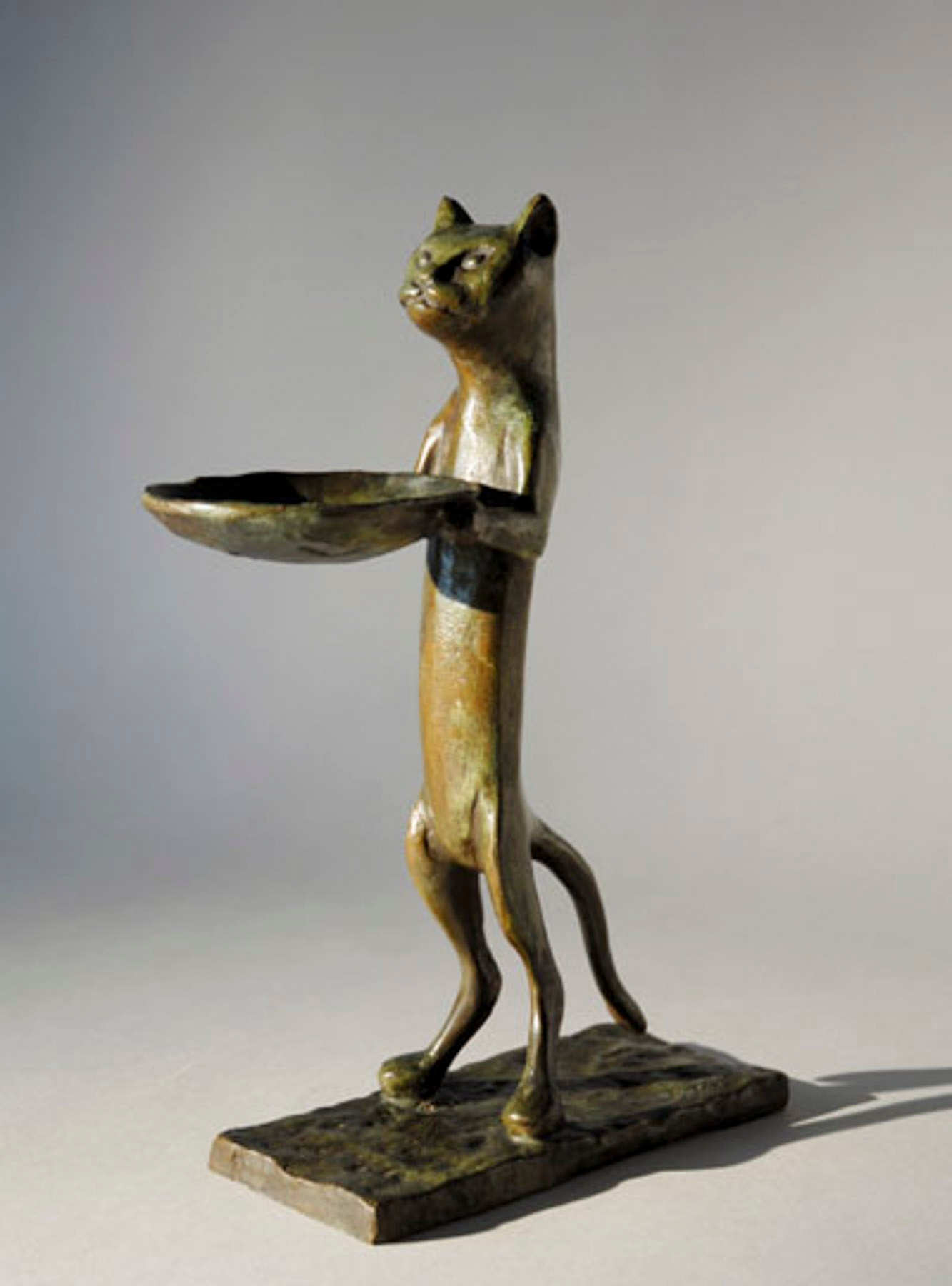
Diego was very much like his work. He could be stern and remote, but he was also endearing and given to flights of fancy. His tables, chairs and lamps are solid and straightforward, yet they are filled with suggestions of narrative and overrun with creatures that roamed his imagination since childhood. (Michael Brenson, 1986, The New York Times.)
Deer, mice, frogs, and foxes – all manner of animals figure widely across Diego Giacometti’s bronze furniture pieces and decorative objects. A folkloric charm characterises his often-splinderly and filigreed designs, their textured finish reminiscent of tree bark and branches. Expressively modelled, his bestiary complements considerations of functionality with a sense of tactile storytelling, Diego’s vision of the natural world one of fairytale fantasy – inspired, many suggest, by his pastoral Alpine youth. Such is Chat maître-d’hôtel (Cat Butler), an occasional bowl and stand, in which the titular feline has assumed, in its given professional, an anthropomorphised pose. Given his whimsical inclinations, the artist’s preoccupations are often held in contrast to his brother Alberto’s austerely modernist existentialism.
b.1902, Borgonovo; d.1985, Paris
For a good deal of his life, Diego Giacometti was overshadowed – first by the mountains surrounding the Swiss hamlet in which he was raised, which enjoyed no direct sunlight for three long months each year, and later by his older brother, the artist Alberto Giacometti. That his father, Giovanni, was also a celebrated artist only deepened the shade. Initially overlooked as a sculptor and designer, Diego was often referred to as “the other Giacometti”. His relationship to Alberto, far from being resentful, was one of singular dedication; the pair were inseparable for much of four decades. Having followed his brother to Paris in 1925, Diego became indispensable as an advisor, assistant and subject. He posed for Alberto almost every day, and his likeness soon became the primary motif of Alberto’s practice – it even intrudes, however unconsciously, in Alberto’s own self-portraits. In addition to his role as muse, Diego produced armatures and bronze casts for his brother's sculptures, and patinated many of his works. His technical skill was of invaluable service to Alberto’s preeminence. While Diego began producing his own works in parallel to his brother, it wasn’t until Alberto’s death in 1966 that the younger Giacometti set about his own practice in earnest.
While hugely prolific in the twenty years that followed (he produced an estimated four- to five-thousand pieces, for which there is no comprehensive catalogue), Diego largely refused invitations to exhibit his work. Having finally gained recognition as an artist independent of Alberto, his ambitions, as well as his living circumstances, remained modest. The Giacometti brothers, as Diego’s obituary in The New York Times reads, “were raised in an environment that had one foot in the Middle Ages and another in the cultural life of the modern world.” Diego, by all accounts, continued to straddle these two timelines –
Throughout his success he remained in the same tiny studio, filled with dusty shelves, old tools, coats of plaster and adopted stray cats. In his small house nearby, there were other cats, few comforts and no signs of the late 20th century except for a large television set. With his house wedged in by highrises, he became increasingly the embodiment of an older rural Europe that has largely vanished from contemporary European urban life.
Diego’s final commission and singular achievement was designing the fittings and furniture for the Musée Picasso Paris. He did not, however, live to see the reception of this project. Diego died in July 1985, two months before the museum was inaugurated.