Charles White
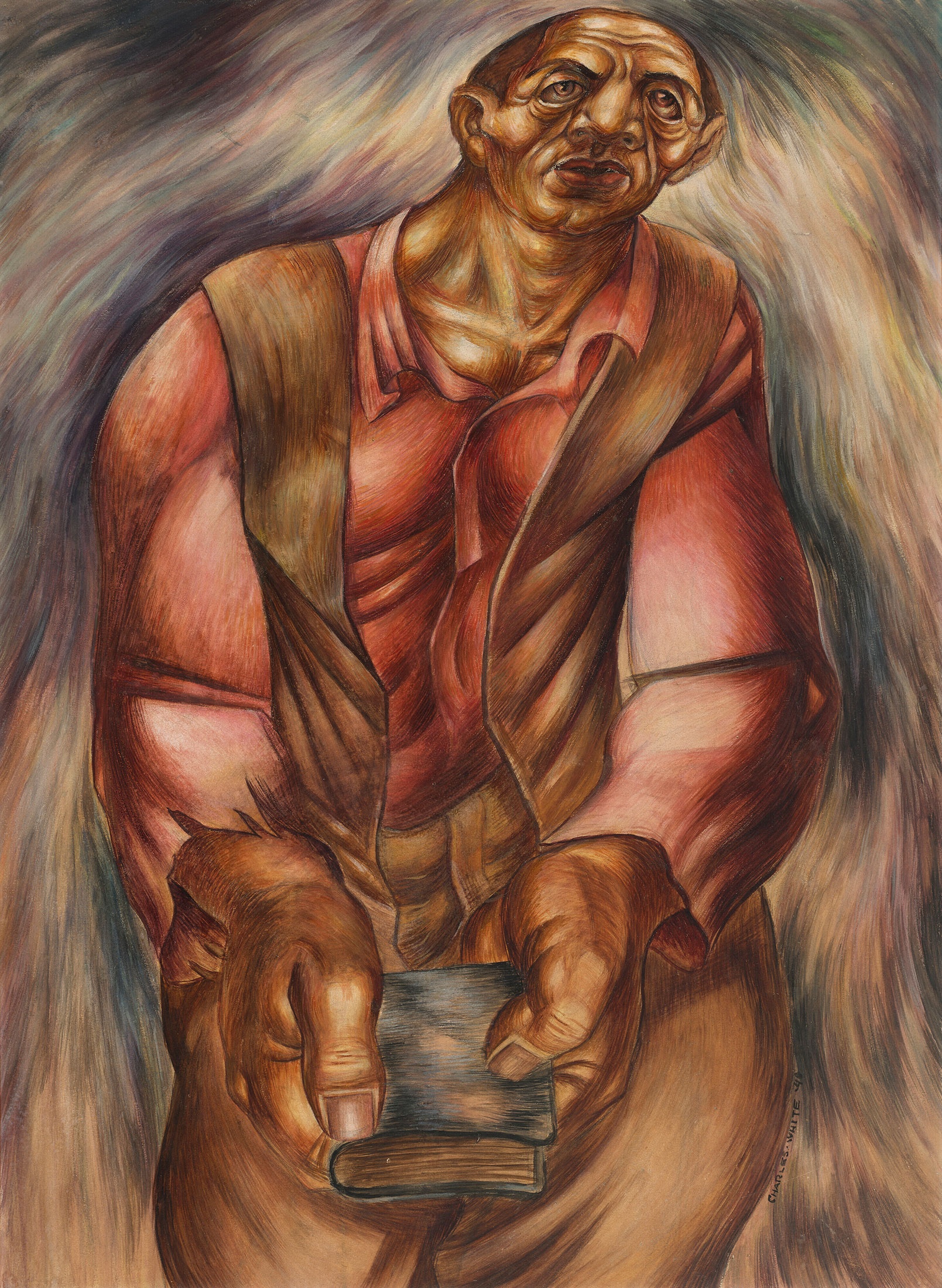
Made when Charles White was only 21, Preacher (Reverend Man) announces the formal dexterity and singular vision that would come to define the artist’s career. Painted in fine brushstrokes of tempera, an otherwise uncommon medium in the artist’s work, the image has about it an undulating – even unsettling – rhythmic quality. The titular figure, who carries no sign of his ordained status (even his Bible appears an unmarked book), all but fills the frame, his enlarged hands and the message they hold the focal point to which the eye is repeatedly drawn. The title alone confers his faith. Failing to return the viewer’s gaze, he instead glances upwards, towards some unseen promise of salvation. The work is startling for the physical presence of this man and the emotional texture of his countenance.
The year this work was painted, 1940, saw White achieve national exposure: he was featured in the Harlem-based publication Opportunity: A Journal of Negro Life, in which he was described as the “best draughtsman” of his generation; completed his first public mural, Five Great American Negroes, at Howard University, Washington DC, where he was artist-in-residence; and was included in the Tanner Art Gallery’s comprehensive survey Exhibition of the Art of the American Negro (1851–1940) in Chicago, the catalogue for which featured his work on the cover.
b.1918, Chicago; d.1979, Los Angeles
“Paint is the only weapon I have with which to fight what I resent.” Raised in Chicago’s South Side, Charles White would become a preeminent figure of the city’s Black Renaissance in the 1930s and 40s, “a true master of the pictorial art,” as his former student Kerry James Marshall wrote in ‘A Black Artist Named White’, a feature published by the Paris Review in 2018. “Nobody else has drawn the Black body with more elegance and authority.” Despite his precocious talent as a draughtsman, White’s ambitions as an artist were initially deferred when his acceptance to two art schools was revoked on account of his race. He later enrolled at the School of the Art Institute of Chicago in 1937, where he was awarded a full scholarship. Shortly after graduating, his political commitments were galvanised during a brief period spent teaching at a college in New Orleans, where he witnessed the subjugation and humiliation of the Jim Crow South. “The more I learn of the history of my people and country, the more I experience of the stirring events of our time, the more are there subjects which clamour for realisation,” he later said in 1955, the year the Montgomery bus boycott precipitated the civil rights movement. His four-decade-long engagement with expressive figuration, at a time when abstraction was the preferred modernist mode, was predicated on his belief in art as a tool for radical social change –
Art must be an integral part of the struggle. It can’t simply mirror what’s taking place. It must adapt itself to human needs. It must ally itself with the forces of liberation. The fact is, artists have always been propagandists. I have no use for artists who try to divorce themselves from the struggle.
Across his public murals, easel paintings, drawings and prints, White remained dedicated to what he called “images of dignity”, expressive compositions that figured 20th-century black American experience with a focus on poor and rural communities. In addition to his pictorial contributions to the struggle for racial equality, he is remembered as an influential educator, particularly in his teaching position at Otis Art Institute in Los Angeles (now Otis College of Art and Design), where he mentored, in addition to Marshall, leading black artists like David Hammons and Faith Ringgold, among others.