Lin Yilin
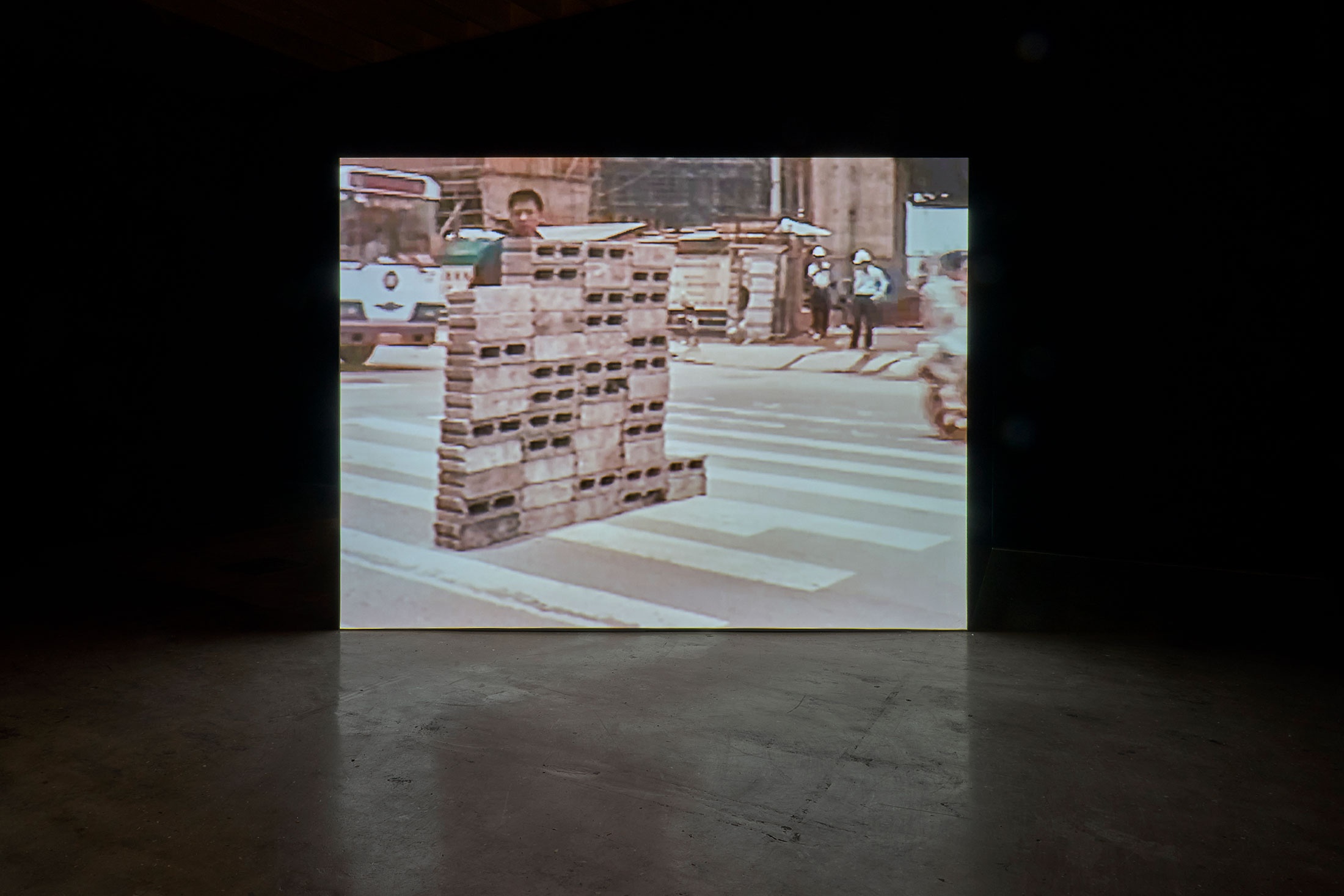
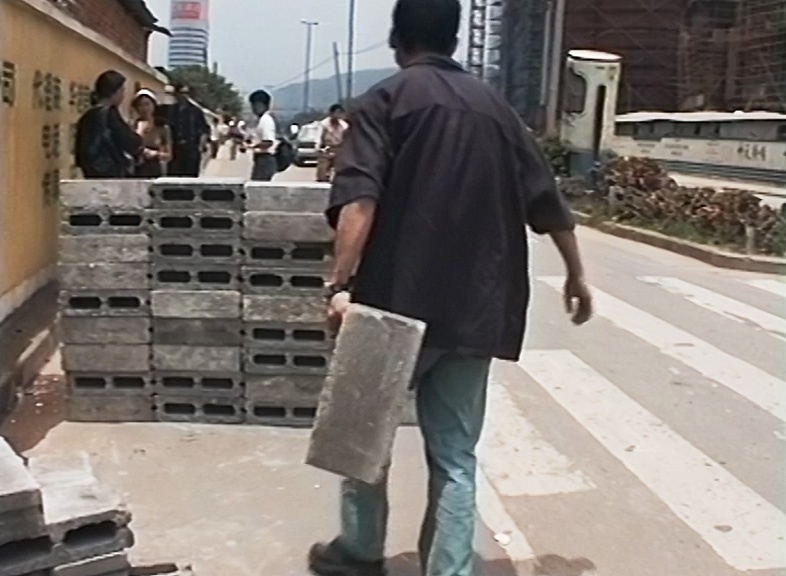
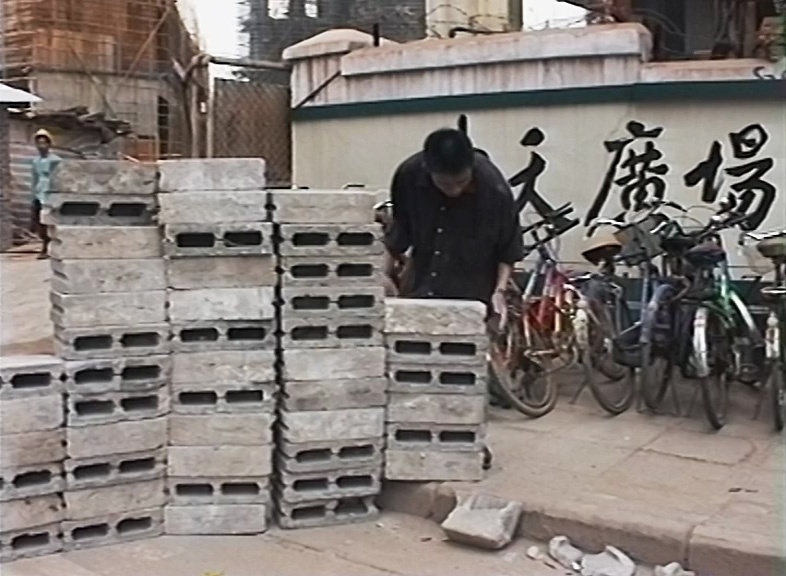
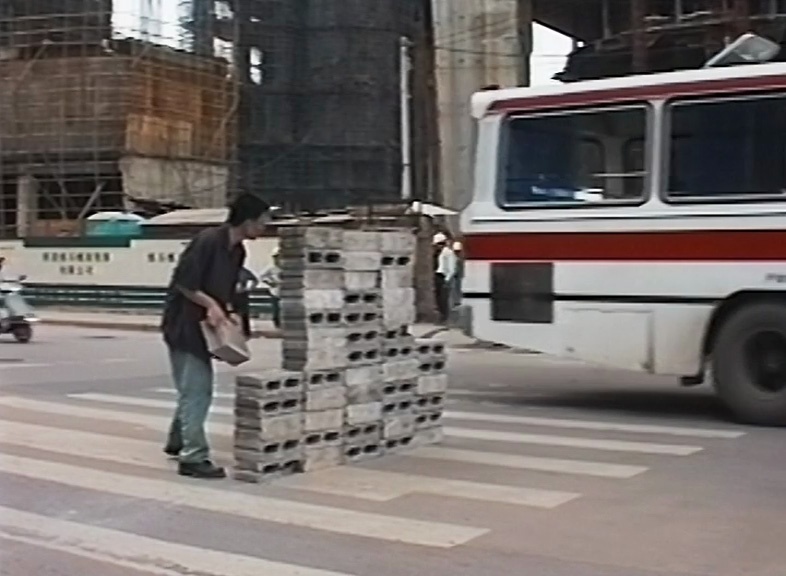
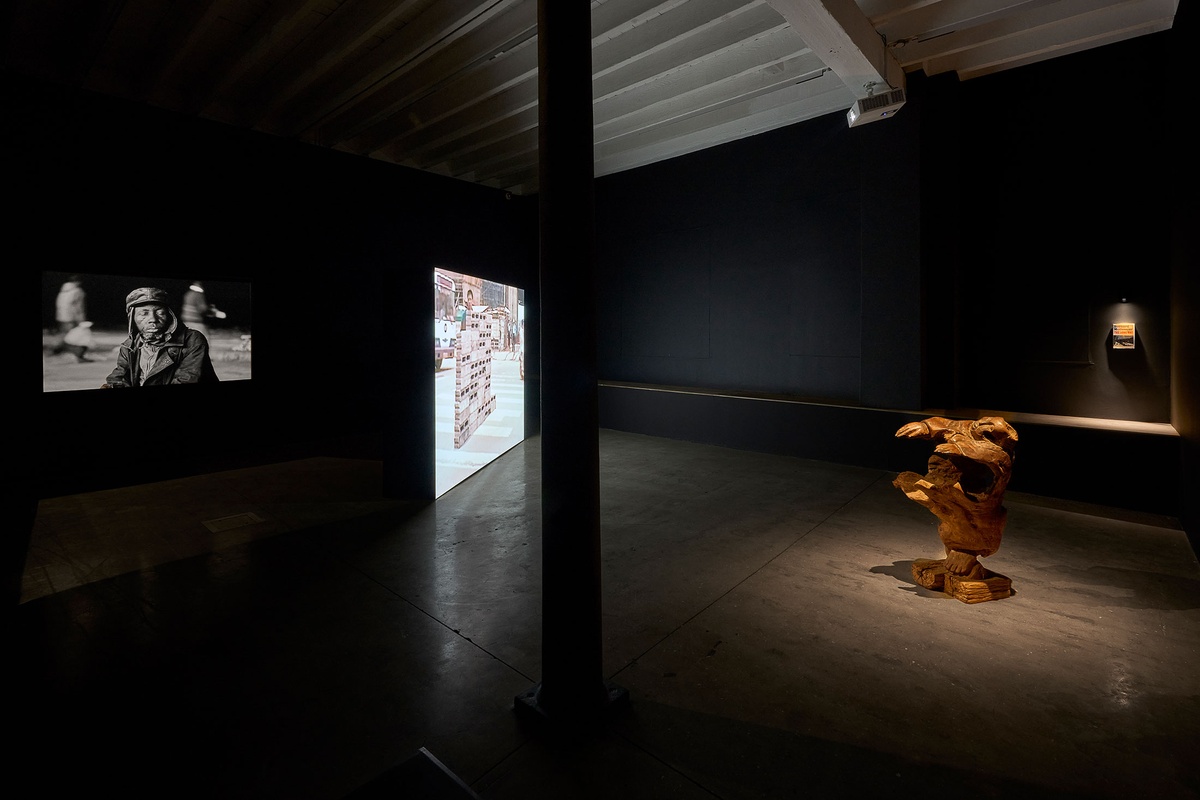
The premise is straightforward enough: to move a wall across a road, one brick at a time. The context, however, is somewhat more complex – and the doing demanding, even dangerous (the word ‘safely’ in the title suggests the perils of the task). Lin He Road was, at the time of this intervention, a major thoroughfare connecting the nearby train station to Guangzhou’s newly conceived commercial district, then under construction. The building site, visible on the far side of the road where Lin Yilin staged his performance, was intended to be the tallest skyscraper in Asia, a testament to China’s economic optimism in the early 1990s, which saw rapid urbanisation across its southern cities. Against this vertical symbol of fast-paced change, the artist’s slow horizontal progression plays.
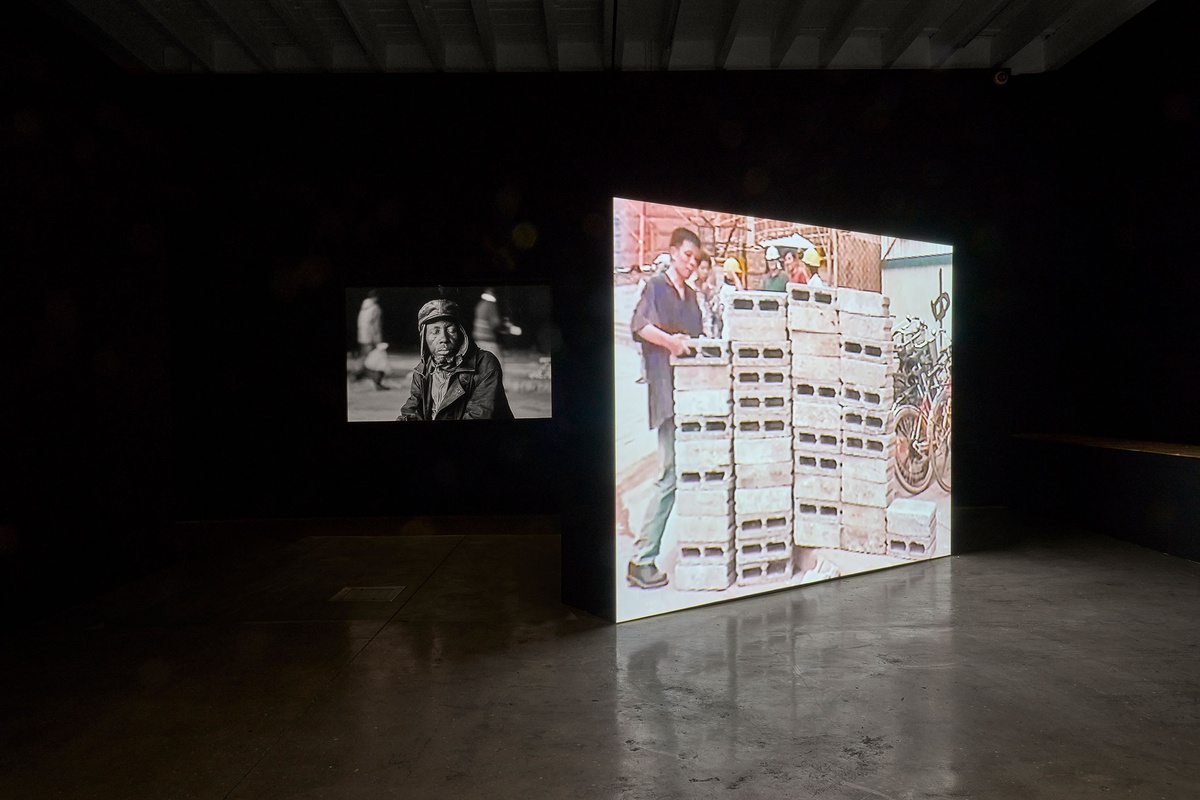
One by one, Lin moves each of the 48 bricks in repeated sequence, travelling his wall along the demarcated pedestrian crossing. He works with quick efficiency, does not pause for or apologise to the passing traffic, appears insensible to any inconvenience caused. The ambient sounds of the setting accompany the scene, punctuated by the hoots of passing buses, cars, and motorbikes. Nearby construction workers look on with mild bemusement; drivers slow to stare; a modest crowd of friends meets the moment with studied seriousness. No one otherwise interrupts the artist at his labour (Lin purposefully staged the intervention at lunchtime, when there would be fewer police and traffic officers about to frustrate his ambitions). The effort of the exercise, which took an hour and a half to complete, crossing four lanes from one pavement to the other, is summarised in this 30-minute film.
In addition to discrete performances such as this one, Lin was a founding member of The Big Tail Elephants Working Group in 1990, a Guangzhou-based collective that held public happenings and exhibitions in response to the city’s accelerating urban development, drawing parallels between spatial planning and the social construction of meaning. Safely Maneuvering Across Lin He Road dovetailed with these enquiries, citing the ubiquity of building materials in the commercial district. In 2001, when the artist emigrated to the United States, his preoccupations broadened to include migrancy, globalisation, and geopolitics as reflected in diverse civic landscapes. Bricks and walls, first introduced in this work, remain primary motifs in his practice.
b.1964, Guangzhou; works in New York and Beijing
In urban interventions of futile endurance, Lin Yilin tests the constraints of social regulation and the politics of public space. The labouring body is central to these efforts, in which a seemingly benign action is repeated with perverse determination, becoming increasingly absurd and serious in its implications. Some invite participants to join the artist in staging prescribed gestures, others are acts of solitary stamina; most play out on the street before an incidental audience. In correspondence with A4 in anticipation of Deep Water, Lin offered the following:
Before each performance, since there is no rehearsal at all, I have to consider whether I am capable of completing the performance. I begin by selecting a meaningful location and defining two points within it. I then imagine moving from one point to the other through simple, repetitive motions. Sometimes the process is reversed, starting instead from the imagined simple actions. Each time, I rely solely on intuition to estimate whether my physical strength can sustain the entire process.
In his ‘self-rotation’ works, Lin traverses a given setting by rolling along the ground – over the Golden Gate Bridge, through a small Swiss town, down a hillside in San Francisco, and up the spiral walkway of the Solomon R. Guggenheim Museum’s rotunda. In two further performances, One Day (2006) and Triumph (2009), he navigates through a city district on foot, with one wrist handcuffed to its corresponding ankle. Lin makes no grand claims, certain not to confuse these durational actions with physical feats: “Strictly speaking, the movements used in my performances are simple, and anyone could perform similar actions.” On vulnerability and suffering, he offers: “In all my performances, I have experienced only one instance of a superficial bruise on my chest…the injury was accidental and unforeseen, and the sensation of pain has nothing to do with my work.” The artist stresses ordinariness: “My body is naturally sluggish, and I usually lack exercise, yet in the moment of creating a piece, my physical energy bursts to its limits… Still, these limits are only those of an ordinary person – most people simply would not choose to undertake actions that offer no reward.” Lin’s interventions are arresting precisely for this tension: the clarity of a single verb – to roll, to stoop – made strange in its relentless repetition, like the same word spoken time and again.