Oliver Osborne
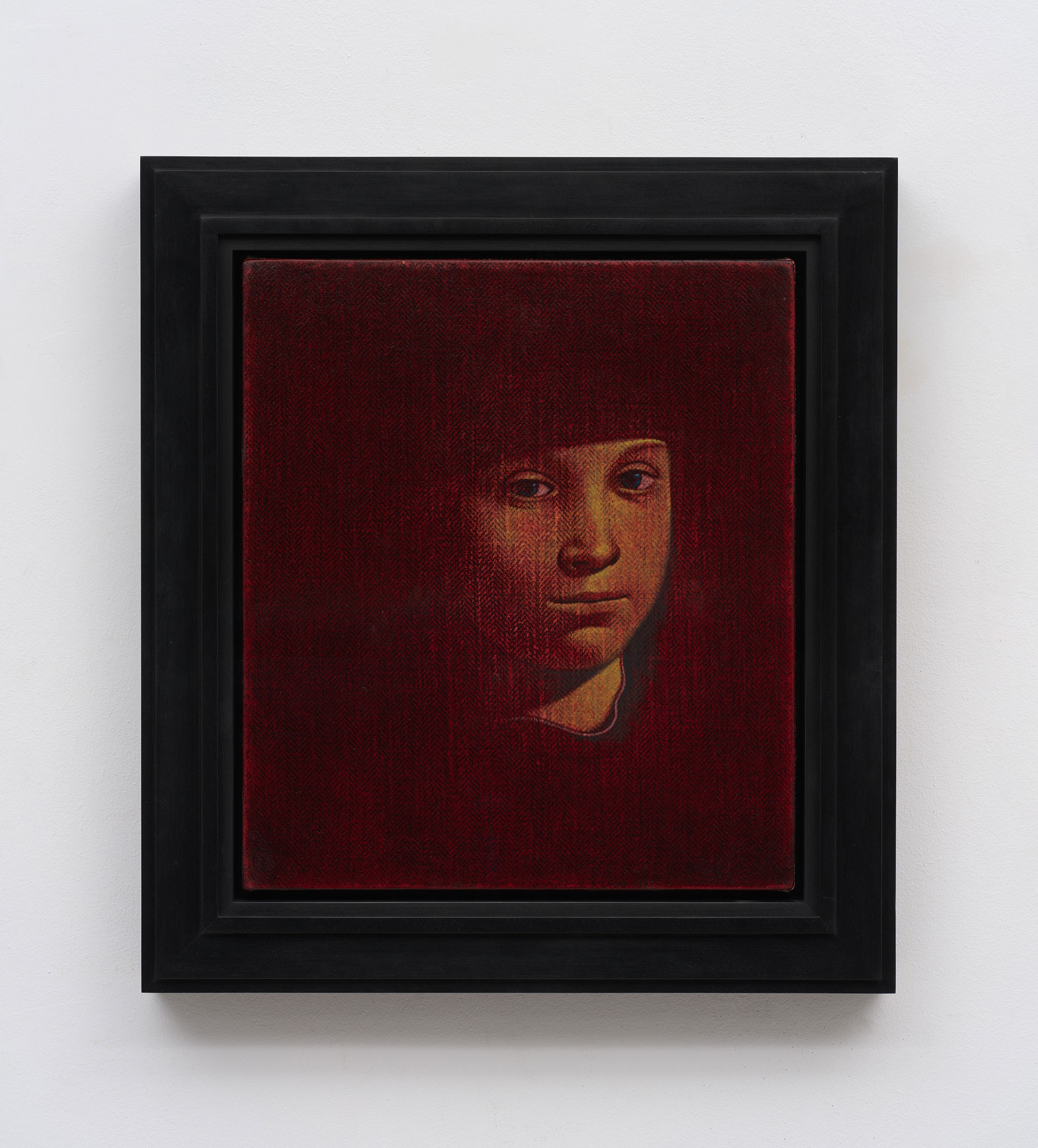
Untitled is less a pastiche of the past than an intimate enquiry into the value of figurative painting in an age defined by a glut of instant images. “Painting, or the practice of painting, is incremental,” Oliver Osborne says. “It requires pragmatism and patience.” In this work, historical allusions to the Italian Renaissance are drawn into the present, the artist rehearsing Giovanni Boltraffio’s Francesco Sforza (il Duchetto) (c. 1495). This study after the painting by Leonardo da Vinci's pupil complements a series featuring Osborne’s sons, each figured in a similar style, all shadows and sfumato softness. The artist’s reflections on time, distilled in these familial and art historical portraits, are threefold: that of time spent in the studio, labouring over considerations of light and likeness; of the collapse of distant and contemporary time such restagings suggest; and of time’s passing, recalled in the brevity of boyhood. “Painting has another lifetime,” Osborne says of his medium’s longevity. “Perhaps a more consequential lifetime.”
b.1985, Edinburgh
At some point, someone described Oliver Osborne as ‘the new Old Master’. The moniker persists, quoted time and again in reviews and features, however imperfectly it describes the artist’s practice. While Osborne is known to reprise art historical idioms and techniques, he is as likely to paint in the manner of Filippo Lippi or Piero della Francesca (at times going so far as to appropriate their images) as he is to engage the cool conceptualism of John Baldessari or On Kawara’s text pieces or reproduce at scale illustrations from school textbooks in the Pop Art mode. A modest rubber tree in his apartment proved a muse of longstanding fascination, as did his children, a few years later. All this to say, he is not committed to any one style or subject; indeed, these seem somewhat secondary to his painterly pursuits. Pressed to characterise his work, one might better describe the artist’s primary preoccupations as repetition, duration, and formal rigour. “Painting’s strength is that it exists in strangely elongated senses of time,” Osborne says. “The slowness of painting means they stop being about the subject.” He positions his meticulous image-making in contrast to the prevailing culture of high-speed visual consumption, and as a continuation of the centuries-long enquiry into the illusionistic qualities of his chosen medium. “How do you make a thing that is made of mud talk about light?” he asks of paint. “All of the technical explorations are about how you can get as much out of this thing, out of a surface which is really only a couple of millimetres deep but can contain a sort of fairly limitless potential for depth.”