Agnes Martin
b.1912, Macklin; d.2004, Taos
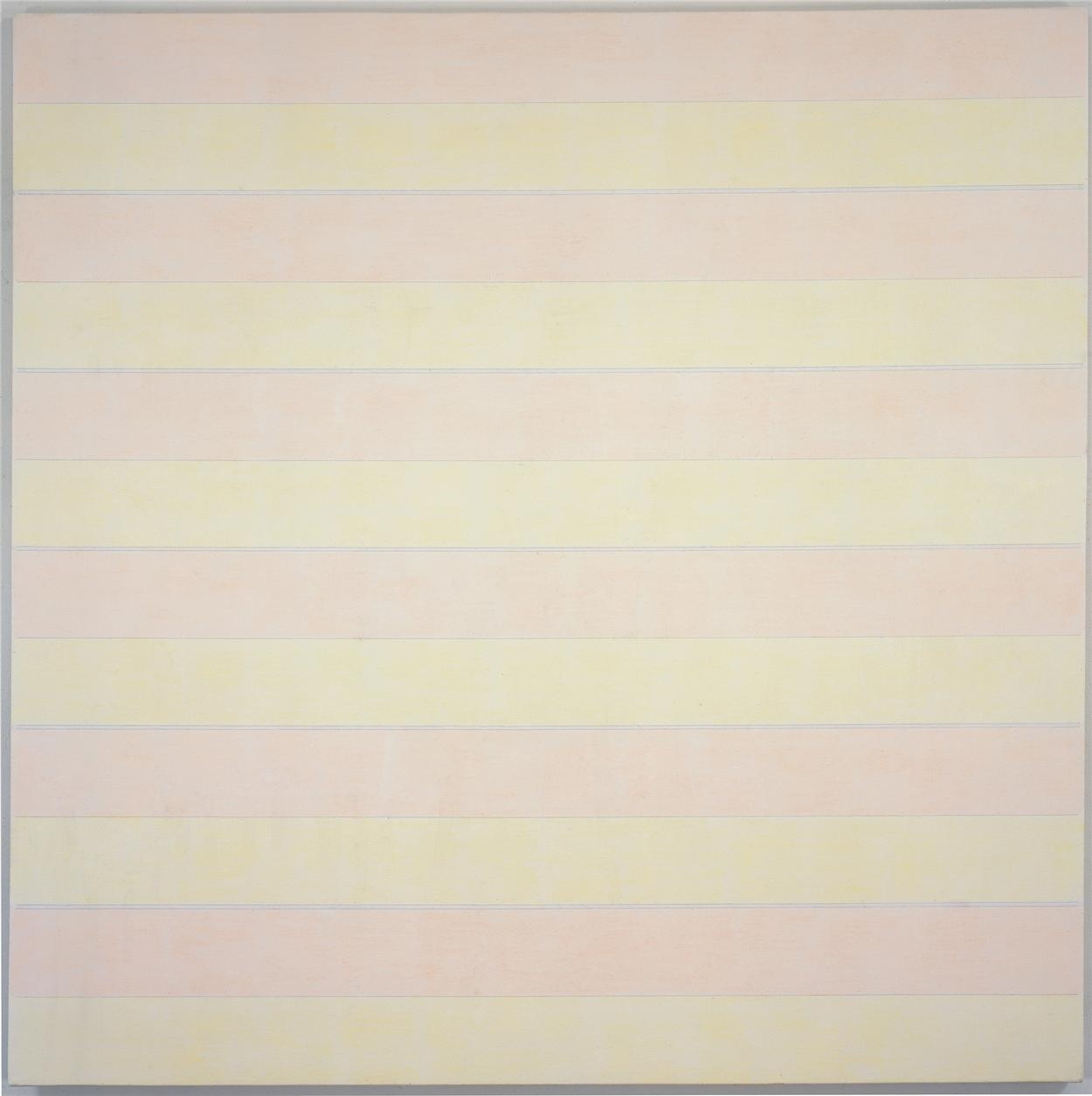
The life of latter-day mystic Agnes Martin is most often summarised in three movements: the artist’s early years (from which few works survive, Martin given to destroying much of what she made), her New York decade beginning in 1957, and the monasticism of her later life, spent in the remote countryside of Taos, New Mexico. In the city, she moved in Modernist circles, aligning herself with Abstract Expressionism’s more esoteric ambitions, however much her gridded canvases appeared a precursor to Minimalism (the latter was too coldly clean-cut, too preoccupied with structure, for her to find much purchase in its pursuits). After leaving New York, and after a pause of almost seven years without painting, her grids gave way to horizontal lines coloured in pale washes of dilute pigment, in part inspired by the ever-present, empty horizon of her desert home. Her perfect seclusion was not without punctuation: throughout the following three decades of her practice until her death in 2004, the artist gave interviews, espousing, if only elliptically, her artistic ideals of transcendence. Of her works, one critic writing for The New York Times in 1976 said, “Her art has the quality of a religious utterance, almost a form of prayer”; of her words, another – John Gruen – observed that she “rarely answered direct questions, but spoke in oracle fashion on matters that seemed applicable to the life of the artist.” Subtle, restrained, even serene – to Martin, her work expressed a “pure devotion to reality,” the artist observing elsewhere, “my paintings are about merging, about formlessness... A world without objects, without interruption.” Speaking to director Leon d’Avigdor, who interviewed Martin two years before her death, she said:
I paint about emotions, not about lines. The truth is that it’s not the lines that express the emotion. It’s the scale of the composition... If the painting has perfect scale, it moves you. And you have different scales to show different emotions. It’s the space between the lines that counts.