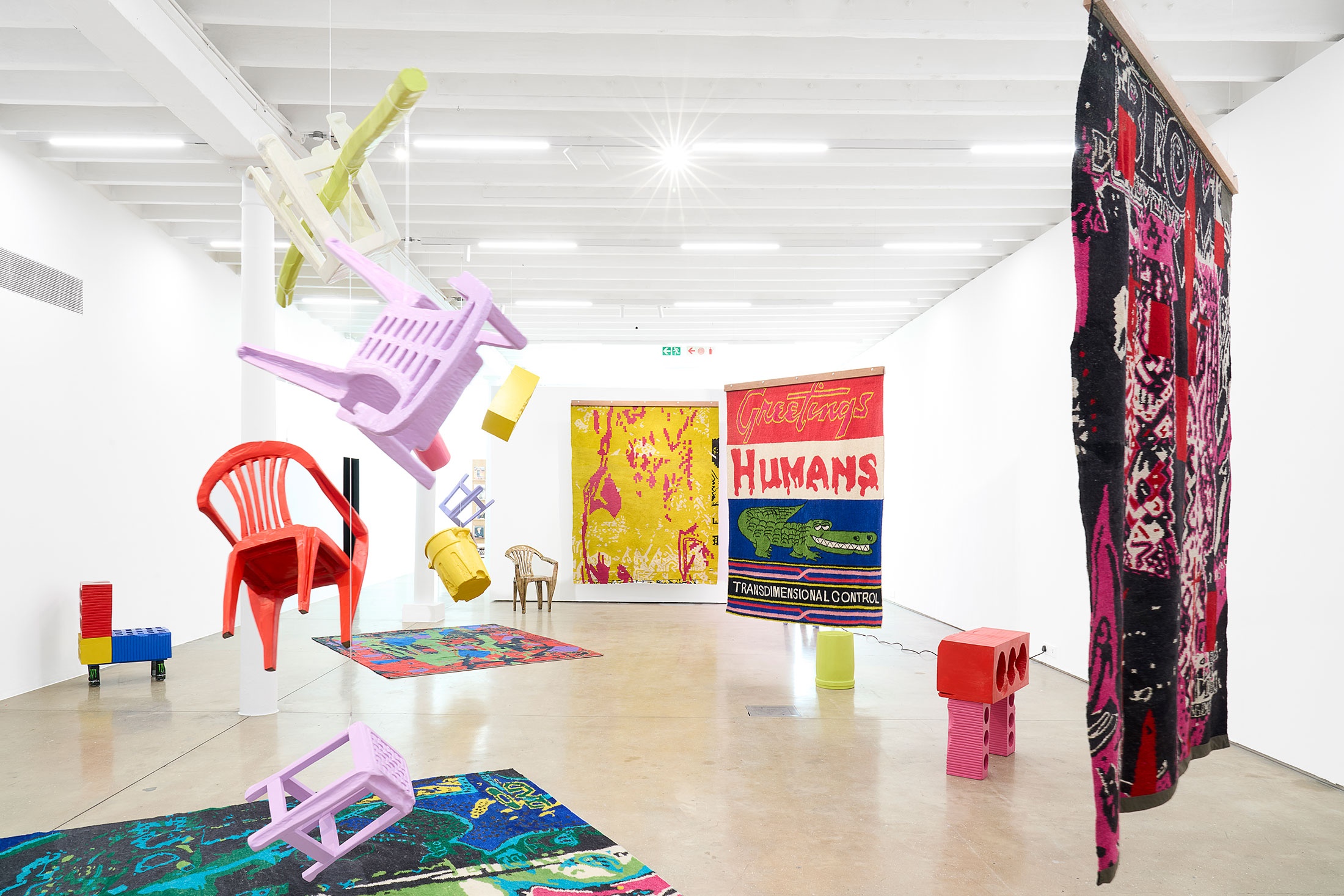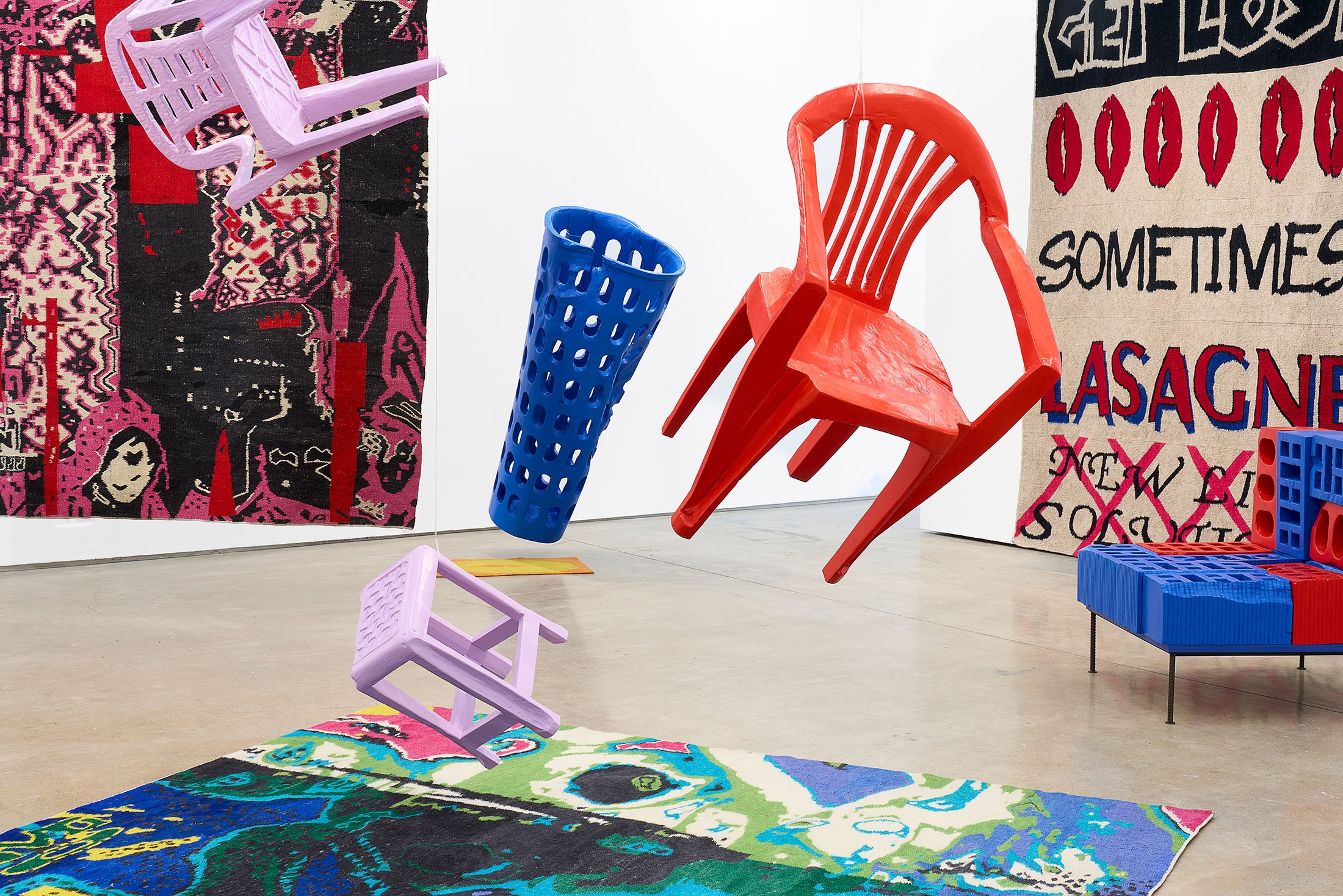
J.G. The gallery looks amazing. There’s stuff lying all over the place.
C.P. Yeah? Thank you. ‘My Work Here Is Done’, you know? Let’s go!
[Ed.’s note: My Work Here Is Done (2026) is the zine A4 published with Cameron Platter that inspired the current exhibition of his work.]
J.G. Exactly! Our plan is to make a first position in the gallery with your artworks, a preliminary sketch in advance of your arrival, and then when you get here you can edit, change, demolish, do as you please, but at least we’ll have put up something to which you can respond.
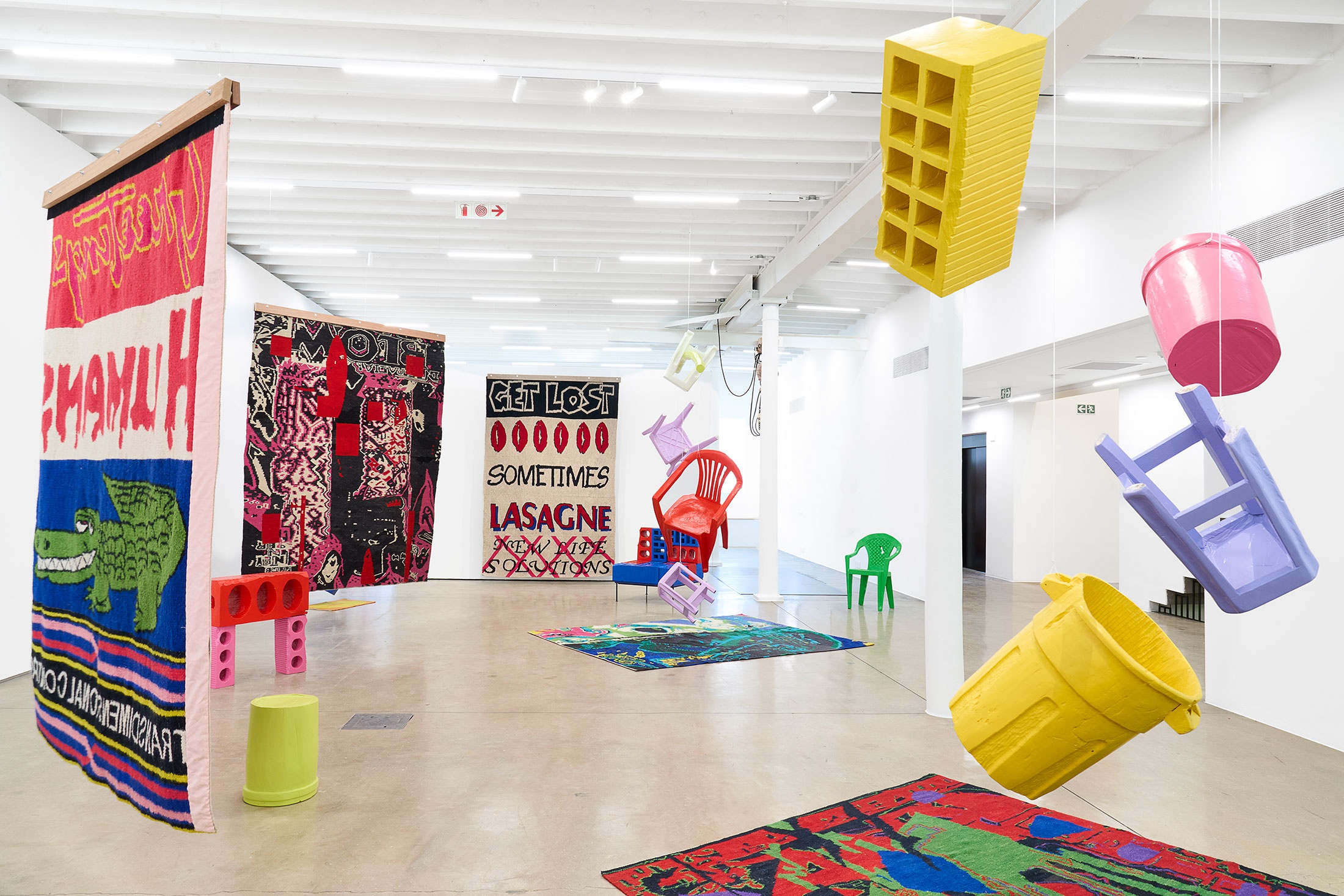
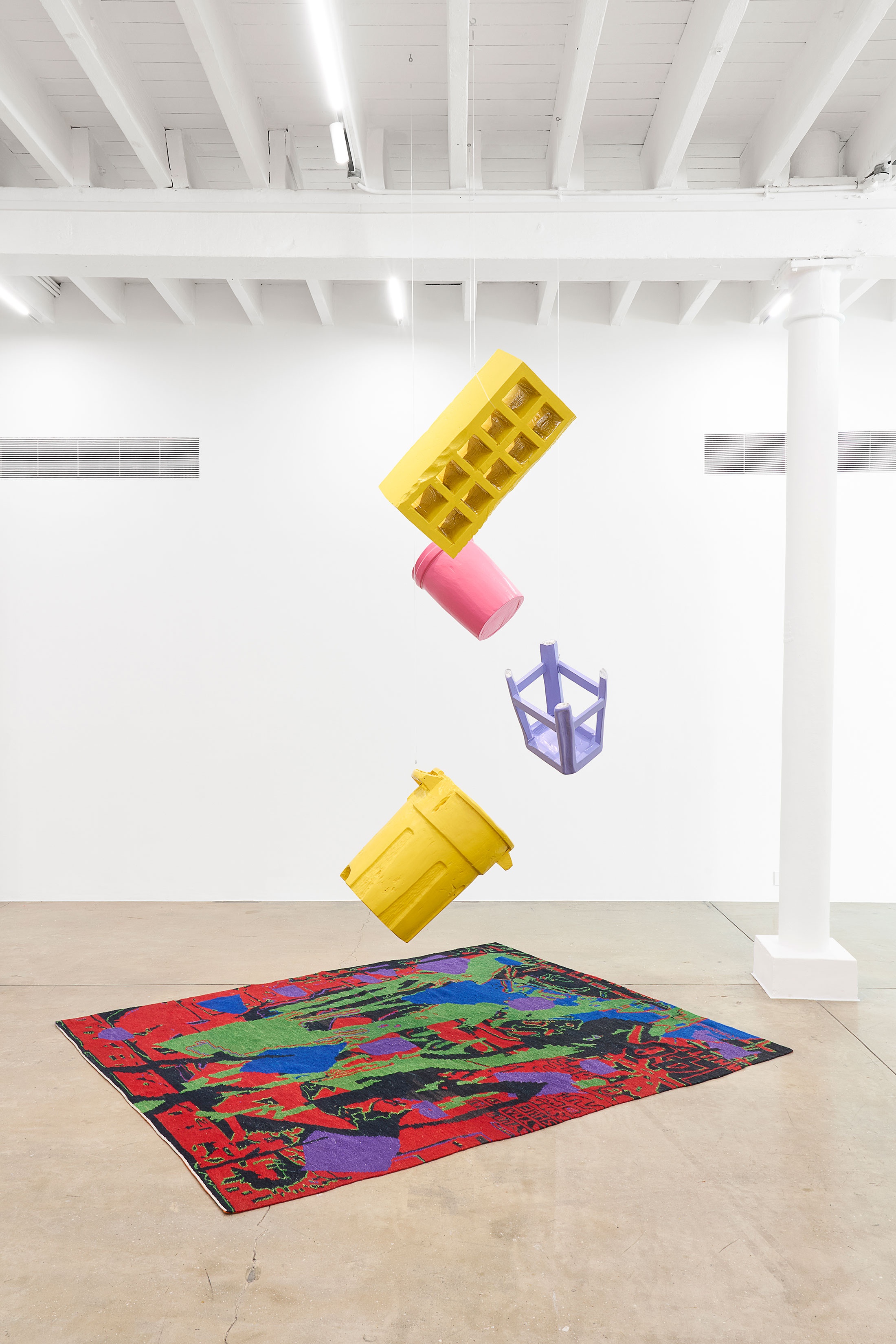
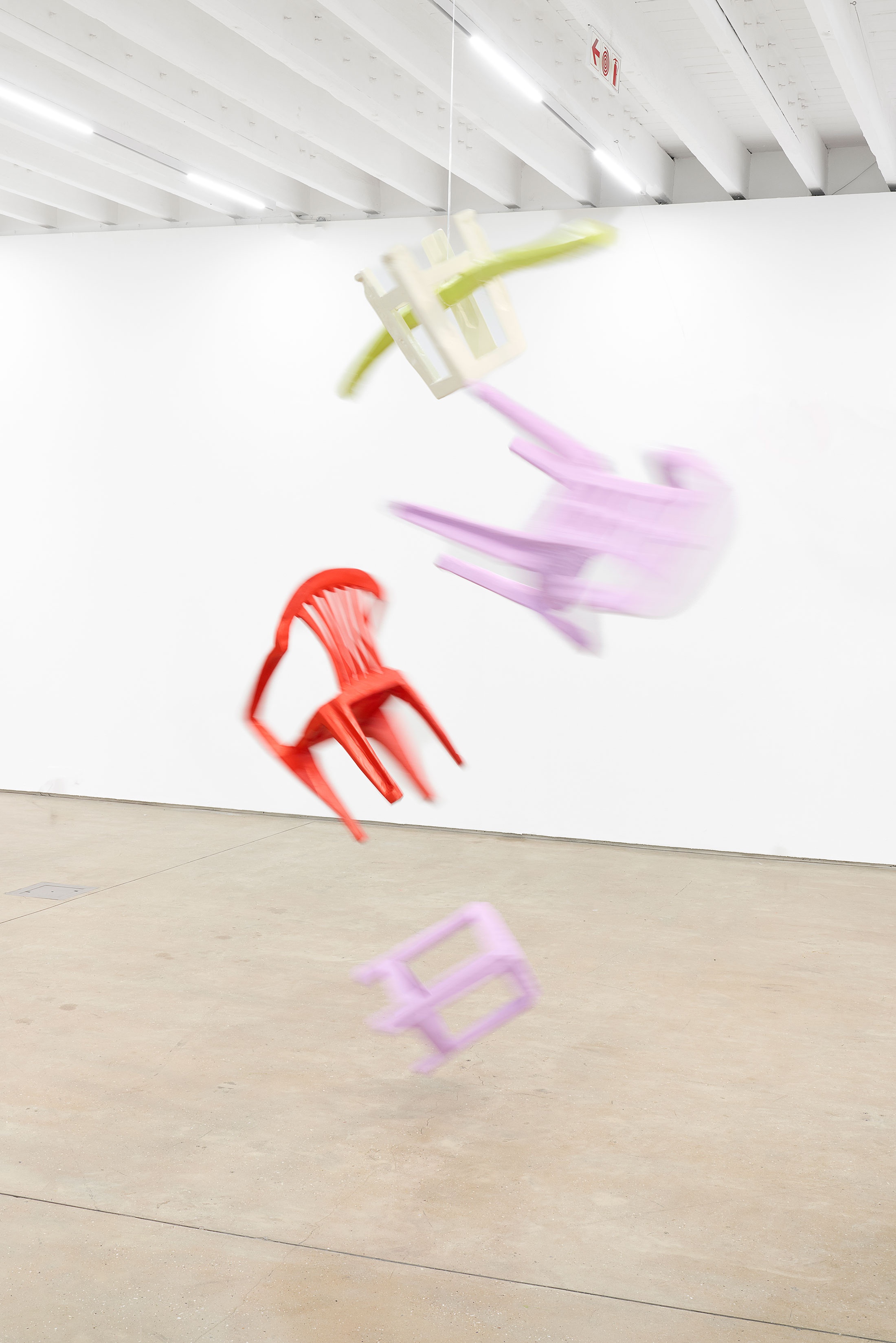
C.P. Okay. I had a sort of a crazy idea to throw at you off the bat. I know this conversation’s not really about this, but we’ve been talking about hanging the tapestries. What about the tapestries on the floor and the sculptures all suspended?
J.G. I really like that. What about we do both?
C.P. Okay, why not? Yeah.
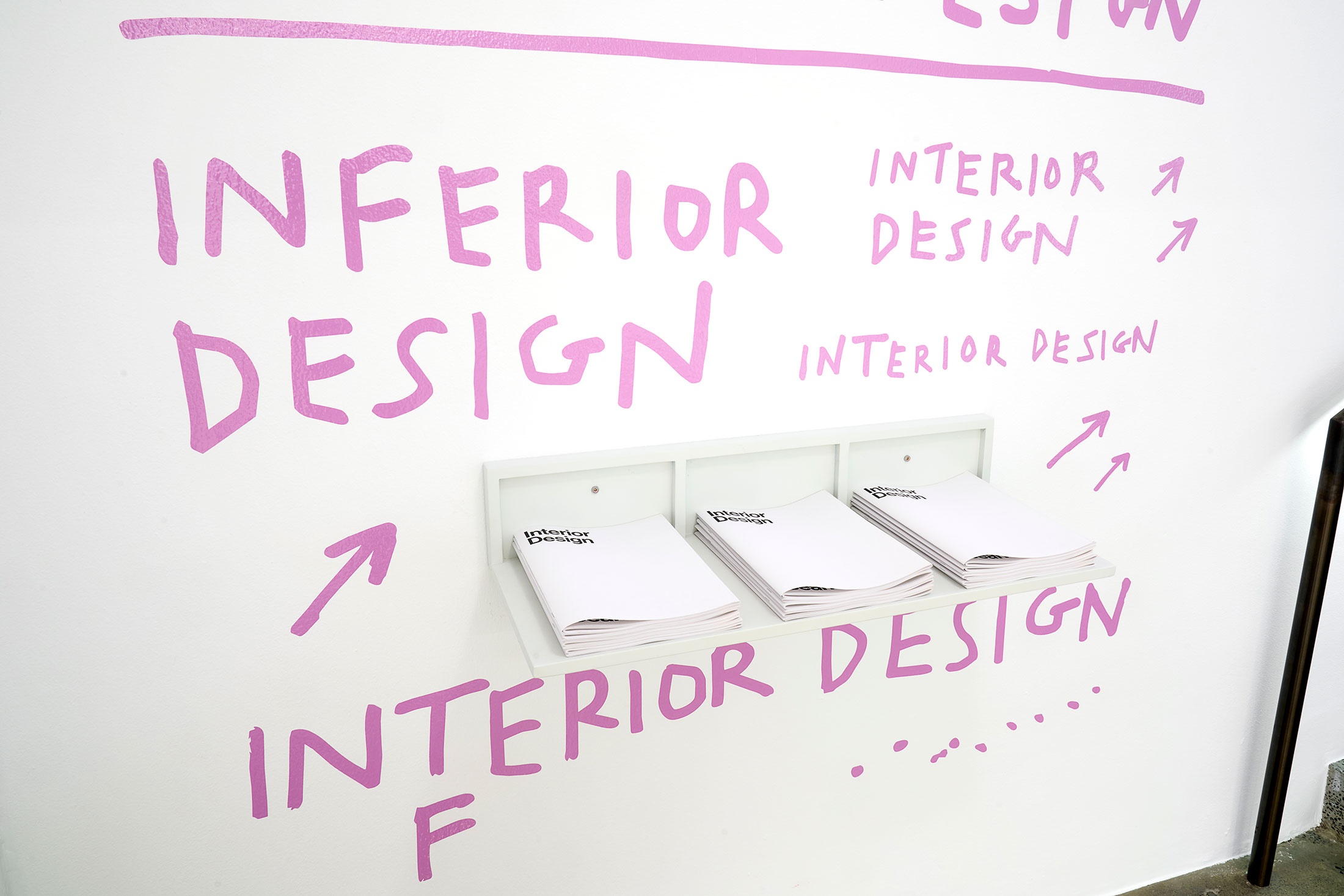
J.G. Because then their hierarchy will be collapsed, if both. What we already noticed is that if we hung all the tapestries, it might be too busy in the space. We’ll test both of those strategies on Friday and see. So in terms of where this conversation is going, it’s for our wayfinder. This document is free – a takeaway from the exhibition. We have a wonderful opportunity to share content and give our community access to the artist in their own words. We’re very proud of these documents – we treat them as publications but we print them at A4 and we keep iterating them. It’s both serious and light. Most importantly, it is a conversation, so you get to ask whatever you want. There’s no bounds necessarily, but we do want to give people an opportunity to get closer to the things you do.
C.P. From my side, I would much rather be asking you guys questions about all the stuff that you’ve seen come through your practice and all the paths that you’ve walked. Sara was asking me earlier before you stepped into the conversation about whether I like or don’t like a particular work. The answer can be quite prosaic and – for want of a better word – boring. I’m always quite curious to find out about other people. That’s how I get into the works as well, by being curious about lots of different things.
J.G. As I stepped in, you said something that I wanted to follow up on. You said, “I love it, but I don’t understand it.” Or “I love it and I don’t understand it.”
C.P. Well, that’s why I find myself doing what I do – it’s because I have no idea what the hell’s going on, you know? When I find something that I really don’t understand, I get a lot more intrigued about it. People often ask, “Well, why do you do that?” I’m always really surprised when artists have the perfect answer: “I do that because of XYZ, and da-da-da.” For me, it’s absolutely not that. There are multiple roots shooting off, dead ends, and meanderings to other pathways. For example, if you ask me why I like plastic chairs, I’ll give you a lot of answers, but those will change every day. And I think maybe that’s why the chairs fascinate me. In a way, they are un-understandable objects.
L.B. I went down to the gallery earlier. Your chairs are arranged very haphazardly at the moment because we haven’t yet developed the installation. I was struck by how they almost become part of this urban formalism – en masse, you’re not reading each individually. They become composite things that collectively add up to something else. I found myself reading them not as chairs so much as parts.
C.P. I don’t really see those as a group when there’s four or five chairs together. I would see 100 chairs as a group, you know? I find it interesting when I see a car pulling a stack of 100 or 200 chairs to a wedding or a funeral. I’ll whip the phone out and try and get a pic, but yeah, while driving, that could be hard. They become these weird sort of…not quite anthropomorphic, but they appear as things that group and cluster.
J.G. Cameron, you said earlier, which I really appreciate, that in effect, the more uncertain or unclear the motivation, the more motivated you are to pursue it. I don’t know whether this is a good way to describe it: there’s a big question mark, or a series of questions, and then there’s this enthusiasm to pursue it, or walk into it. What happens if or when it starts to become clearer: do you become less interested and pull away?
C.P. Maybe. But I like the clarity as well. I’m searching for that clarity, you know? Especially within the really uncertain and sort of ‘casino life’ of an artist. I’m always searching for that clarity but when things become too clear I get less interested. Maybe I should become more interested, and be a better brand manager.
J.G. No, please don’t. I identify with what you’ve said. I don’t find it particularly interesting when artists have an absolutely practised response. There are a range of risks when the artist is very clear as to what they intend to do, or why they do it. That’s not to say that the outcomes can’t themselves be uncertain and generate all kinds of curiosities, because they can, but they often don’t. They’re often too prescribed to allow any uncertainty down chain. So I’m very enthusiastic and interested by the opposite: the artist as someone who is willing to step into and negotiate uncertainty productively.
I’m curious to know whether you think that your approach to these mundane objects and the kind of uncertainty associated to the reproduction of them and the negotiation of them translates in any way to your engagement with uncertainty of life at large? Is there an art-life intersection here? Can the lessons learned from embracing uncertainty, in the fashion you do in the studio, afford you any comfort in the world that is at best, uncertain?
C.P. I wish it would. I hope it might equip one. I’m astounded how people go through life quite certain. It blows my mind. I’m in awe of that kind of artist: they’ve found the Holy Grail. There are brilliant artists that can do that, but I think it’s quite rare. I’m sort of walking around like, oh, shit, shit, the whole time…
Maybe that way of looking and engaging, whether with one’s own art or the artworks of another, is about attention, about giving that attention to an odd object. This can translate into giving that attention to other aspects in life as well. But it doesn’t make it any easier, if that answers your question?
J.G. From what I’ve seen, a lack of uncertainty is the remit of the maker who treats art more like design. And I don’t mean design here in a negative light. I mean, to solve a problem, applying a design logic that is conscious of the infrastructure, recognises and presents a solution to a problem.
Can we return to something you said earlier? You said the “casino life of an artist”. Can you explain that?
C.P. It’s kind of obvious. It’s the real up and down. It goes back to the uncertainty, the chance, the randomness of it all, of being in the studio and picking up something, even that thing you’ve thrown away, and suddenly it appears to you in a new light. For example, looking at those tapestries on a ladder and seeing how they came together, you know, it’s those chance elements.
Being an artist is, at least in my experience of being an artist – it’s not like being a salaried person. There’s nothing guaranteed in it. I think that’s why I’m drawn to casinos as a subject. I’m not a gambler at all because I’m engaged in gambling every day in my studio and my work. The studio is a metaphor for me.
J.G. Lucie, does this bring up anything for you in relation to what you’ve been recently writing about Cameron’s practice?
L.B. The relationship to unknowingness that you mention, Cameron, is curious, because you often iterate on the same form, like the plastic chairs or your bumper sticker tapestries. When one first embarks on a new form, or one is testing materials, it makes sense that there’s unknowingness, but that you can hold onto not knowing, even while you reproduce along a similar vein… I suppose I’m curious about this in relation to a conversation we had about art and therapy – iterating, repeating, revisiting – and in relation to the title ‘Interior Design’.
[Ed.’s note: Cameron later iterated on this propositional title to name his installation ‘Inferior Design’. The three-part project in the gallery retained the title Interior Design. It was initially named for his project, like the title track of an album.]
C.P. Yeah, I mean, to me, art is definitely the way of processing things around me. If I return to a subject again and again, be it a chair, or a crocodile, or a casino, that’s because I haven’t quite figured out what it is or what it’s doing for me – what message it’s sending out to me. I’ll return and work on things over years and years. And I know, when I’m returning to certain things, and they’re coming up again, that they’re there for some sort of reason. To do a little jump into the therapy thing, there’s some sort of processing going on there.
L.B. Have you ever felt that you’ve reached some sort of resolution and you therefore have to discard that particular line of enquiry or that particular material experiment?
C.P. No. I think it gets a little quieter, maybe, and then it’ll pop up in another way. Certain works, when I make them, I think, “I really don’t understand this. I don’t like this.” In the back of my mind, I know that those works that I have that kind of feeling towards often jump up again. Certainly it’s that way with the chairs. I guess I’m looking for this particular quality in a lot of different ways in the works that I do: an open-source quality, whether it can be pirated. Something like that. I’m sort of making pirated versions of chairs, tables, tapestries.
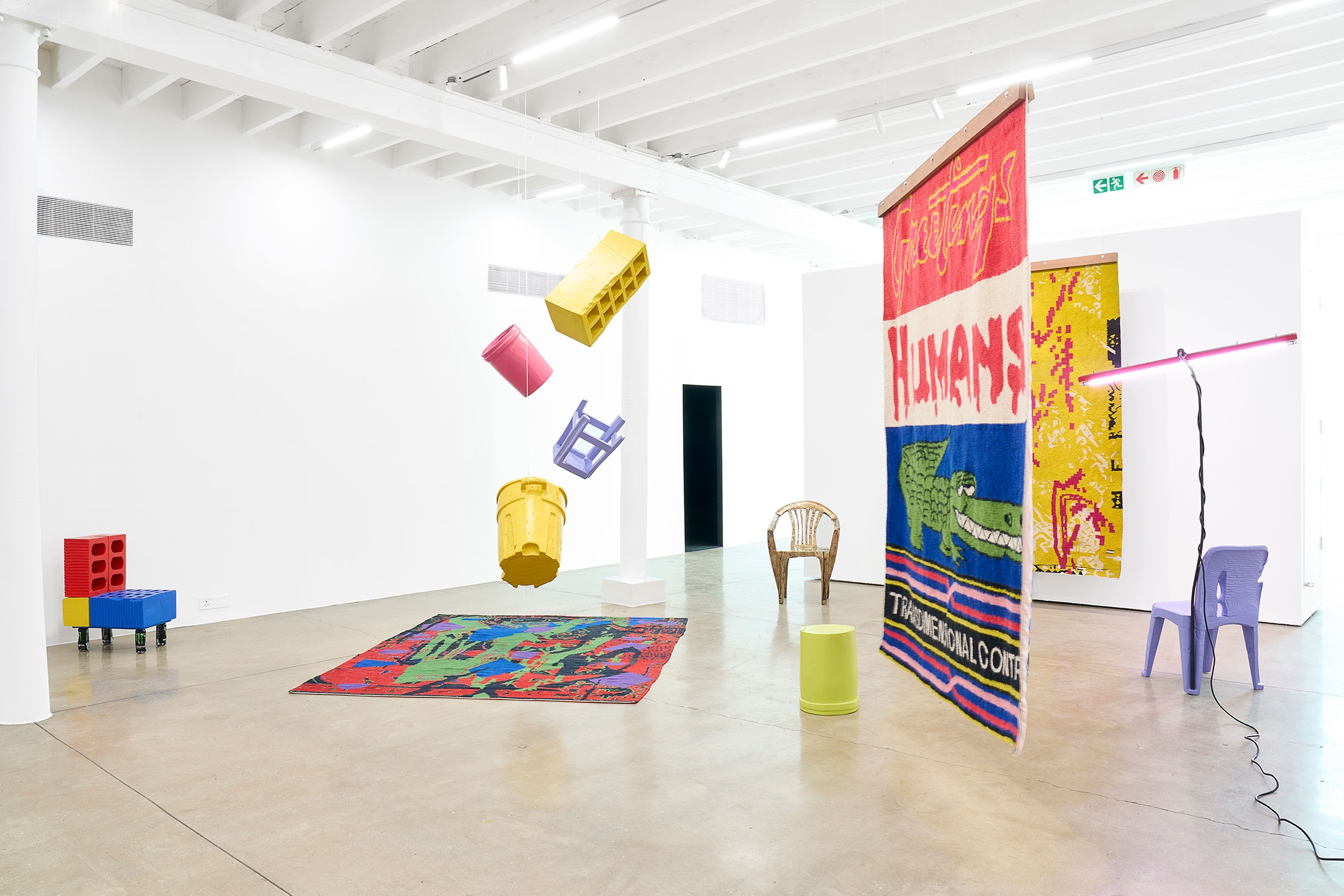
L.B. You find the chairs. They have a certain patina to them. I’m curious as to how that history of use is actively translated into the wooden sculptures or if it’s just part of the game of making that you have to find them in the world – that they can’t be store-bought, brand new plastic chairs from Makro.
S.d.B. Lucie, would you mind detailing this process of Cameron’s chair finding, the way you understand it to be? For the sake of this document it would be good for people to be able to read that origin story.
C.P. Go for it, Lucie.
L.B. I’ll tell you what I understand, and you can tell me if I’m correct.
C.P. Sure.
L.B. You trade new plastic chairs for ones that have a history of use that you find in the urban or suburban environment?
C.P. Yes!
J.G. But they’re haphazardly found? You might just be driving past someone and see them sitting on a chair on the porch and think, “Hmm, I like that chair. Let me see if I can find an equivalent and trade it with them.”
C.P. Well, yeah. I’d see a chair. I’d think, “Damn, that would be good.” The trade is not really the crux of the project, but in doing a number of these trades, I’ve realised that exploring that aspect would be a fascinating project in and of itself. But to respond to Lucie, I’ve got nothing against a store-bought Makro chair. If it’s got a good shape, I’m into it. But there is a wonderful thing about seeing a chair with patina, with life on it, with history on it, and then engaging with the person about it. Invariably, people are a bit suspicious about what I’m up to. This thing that I do, it’s a very odd thing to do! There have often been people who I’ve approached for the chair they are sitting in and they say straight up, “No”. And then I have to leave. When I was doing it actively, I’d actually gone to Makro and bought a whole bunch of chairs, so I had a little stockpile to swap out for. I would go and trade, talk a little bit about the project and its history. Most of the time, people would be like, “Okay, cool, you know, this guy is clearly bonkers. But he’s sincere.”
L.B. It would be great to have transcripts of these conversations and engagements you’ve had with people asking if you can take their chairs.
J.G. I like that you had a batch of chairs, like having a chunk of change when you’re running a lemonade store.
C.P. Yeah, but the problem is I’m not driving around with hundreds of chairs on the backseat. Often, I see a great chair, and I’ve got to get home, and get that new chair, and get back, and then the person’s not there.
S.d.B. If only you could keep a chair in your pocket at all times.
C.P. Exactly. You know, I’ve come back before, and the person’s not there, but their banged-up chair is… I’ll admit there are times I’ve taken it and left a new chair in its place.
L.B. Christmas chairs.
J.G. You said something earlier that’s been ringing for me. John Cage said this wonderful thing about giving the kind of attention that we normally give to art, to the everyday. That’s at least the central tenet of his kind of conceptual practice: listen to the traffic. That will become a sound composition, defined to some extent by giving it a beginning and an end. You’ve got the kind of practice that teaches people to pay attention to the everyday. So, the other day, in Naples, I walked past an office chair, and I thought, “How’s that chair?” This is a function of your project, turning me onto that. [Ed.’s note: Josh shares his screen showing the picture of the scene.]
C.P. That’s a good chair, the office chair.
J.G. These guys – it’s a classic European scene, you know, sitting outside, the older men would maybe in the past have been drinking a coffee, or reading the newspaper, here they’re on their phones. For all three cafe owners I passed, I noticed each one’s chair in a way I hadn’t before. Your project brought me into that world.
C.P. I see chairs. I see chairs everywhere, you know? And that kind of office chair…oof, you know, it’s quiet, it’s got a real little something. I haven’t figured out how to do an office chair yet.
J.G. How are they made?
C.P. The monobloc chair, it’s sort of spat out, singly. One thing, two minutes, no joins, from a mould. I mean, that’s been the highest order of chair making for so long: to have no joints or screws. But with these ones, I’ll find the prototype, and then I work with a Mozambican carver. We’ll then look for trees – sometimes these are trees on the side of the road that need to be felled. I’ll seek out the imperfections in the wood, if there are knots in the tree, that’s gold, for me. They’re roughly chainsawed, roughly shaped, and then they go into a kiln to dry for a couple of weeks before they’re reshaped and painted.
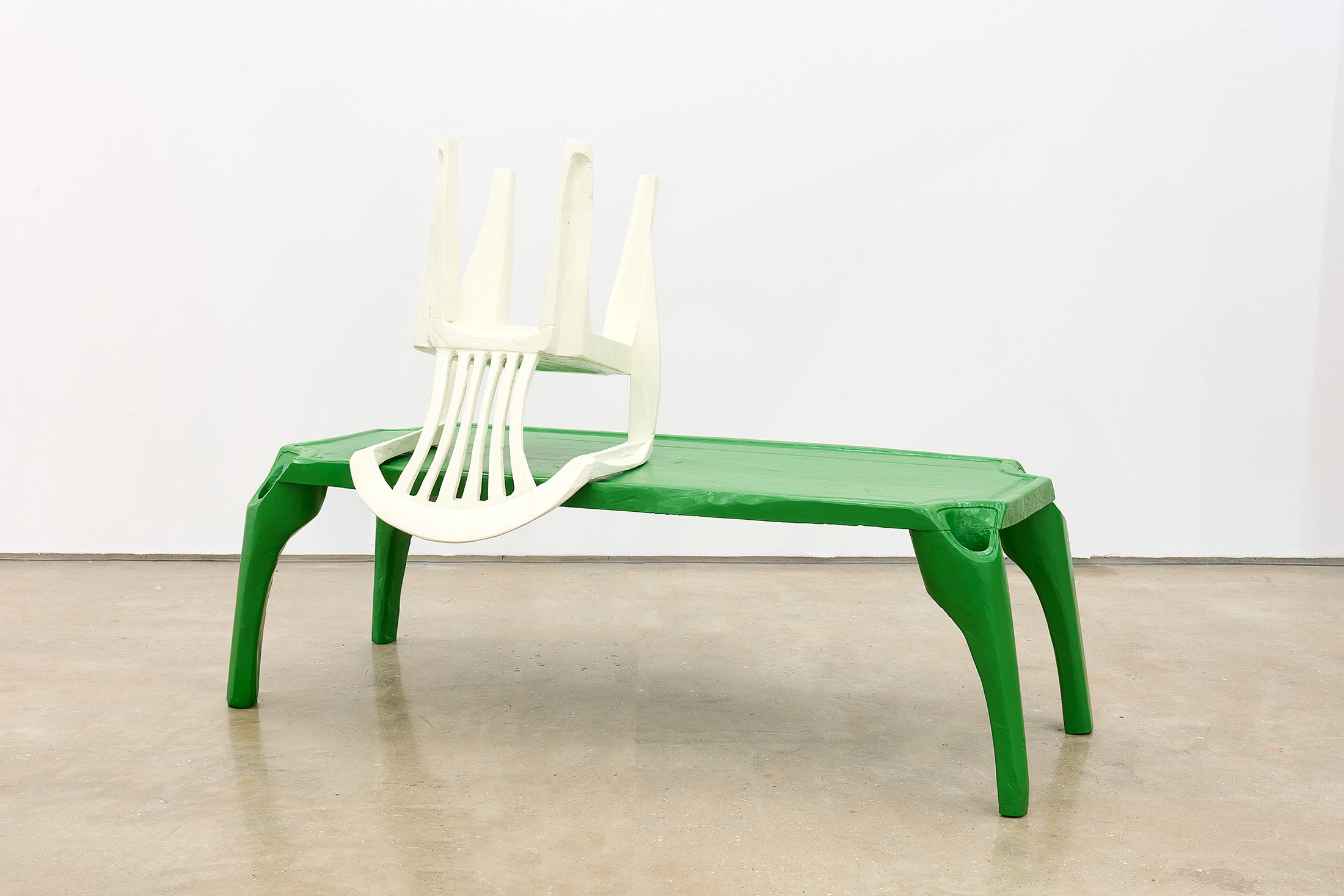
J.G. They’re at once sculptures and chairs?
C.P. I think so. I use them. There are two in this show that I use, that are used every single day in our house – they’re the most ergonomically comfortable ones.
J.G. That’s interesting. The objects can flow in whatever direction you choose. They transform. It’s a wonderful expression of the framing of a thing defining its identity.
C.P. Well, it’s also about hierarchy. I like looking at stuff that collapses hierarchy, whether that’s source material from an advertisement or an energy-drink can or whatever…I think of those as equal as a John Cage piece. I’ll look at them with the same sort of intensity. And this undoes the hierarchy, especially in the art world, where it’s very ‘country-clubbed’.
J.G. But there is a unique, transformative power in your status as an artist that allows you to flatten those hierarchies.
C.P. Okay.
J.G. George Brecht advertised three iterations on a sink in a single newspaper’s ‘classifieds’. First, he listed it as a white sink accompanied by a certificate. Purchasing it entitles you to all the events in which it takes part. Brecht was a Fluxus guy, he’s treating the sink there as a ticket of sorts. Then the sculpture, White Sink by George Brecht, is for sale. Third, a listing of a standard white porcelain sink. The object had three different identities concurrently through his declaration. I’m reiterating the obvious: that you, as the artist, get to transform objects through your declaration: you have the power to change the status of a thing into the singular status of ‘artwork’.
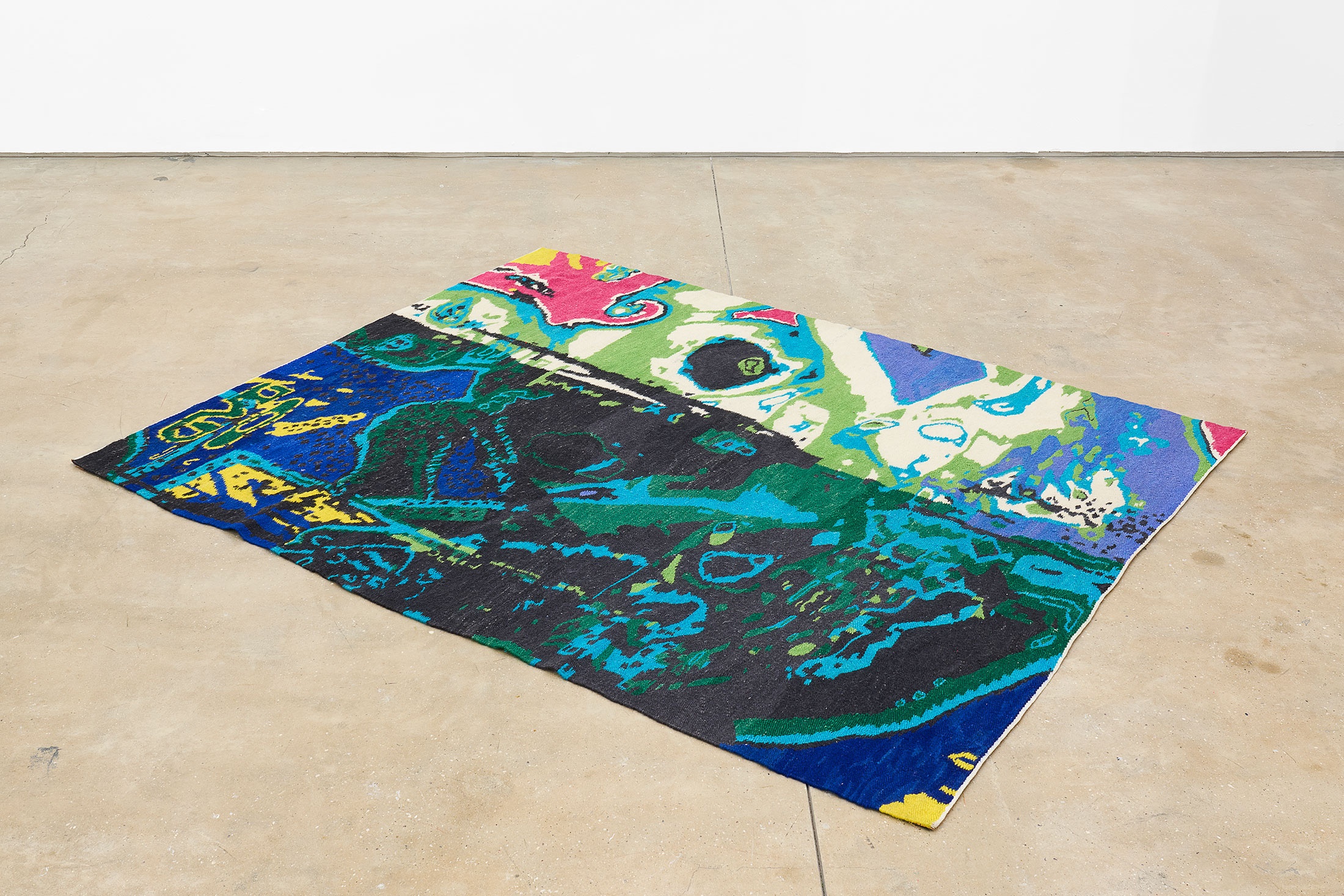
L.B. I would like to speak to the idea of this collapse, because I think the tapestries are a succinct example of this. You’re using either the degraded covers of old porn DVDs, or bumper stickers, and giving each over to this time-consuming process of tapestry making, which is seemingly a much higher form of art than making a pornographic DVD cover might be.
J.G. Yes, where do the porn DVD covers fit it? The illicit, the public, something of the casino in there?
C.P. I think using the porn DVD covers was a refusal of polite society, you know? This was pre the days of porn being accessible everywhere like now where it’s all over the internet. Talking about it in 2026…it wasn’t ubiquitous back then. I refused politeness by rubbing up against unliked things. Again, it is the same conundrum as placing an advert alongside an artwork or the design of a Monster Energy drink as deserving the attention of a painting, for example. I actually found the design work on the covers innovative and interesting. There’s a designer behind each of these DVD covers, thousands of them. The person who did this has taken some care to make it look enticing. Those weren’t made by AI. I came across them in images online, and quite often they would be quite badly pixelated. This was over fifteen years ago. The image quality online wasn’t what it is now. Because of this, they started to appeal to me in a kind of fuzzy, Abstract Expressionist painting type of way. I thought I would see how far I could push that digitally so that it became an abstract piece.
J.G. That was on the cusp of a time when interacting with media was still somewhat discreet. I don’t mean in relation to porn, necessarily, I mean in relation to being exposed to a continuous stream of media rather than the act of seeking out a singular material object like a DVD, or even VHS preceding that.
C.P. I was making them at a time when DVDs weren’t yet completely redundant. They were not yet dinosaurs.
S.d.B. Josh, could you explain how Cameron’s project came to be in the gallery alongside these other two under the shared title, ‘Interior Design’?
J.G. It emerged as we went along. We’ve got two primary ways of using our gallery at A4: the first is ‘the exhibition’ as a standard format and the second is ‘the studio’. I don’t need to detail what an exhibition is – that’s clear enough. The studio is our acknowledgement that the gallery and our gallery are really incredible spaces in which to test ideas. And so we’ll have times where there’s an exhibition, and others where we treat the gallery like a studio and afford ourselves and artists space to test out ideas. It’s not always absolutely clear what the difference is – I guess a certain leniency to how a gallery works? We are more lenient to what the presentation is when we’ve declared we’re working in studio mode: the public is still invited to interact with the space but the focus, in those instances, isn’t on the presentation – it’s on the work and the process. In the past, this has played out as having artists in residence in the gallery, as an example.
S.d.B. The gallery functioning as Cameron’s casino metaphor: putting time and money behind something with no certainty of its outcome.
J.G. Or playing with a real commitment – as an organisation, to the artists with whom we work, and to our community – to express processes as something legitimate and not necessarily something that needs to be fully resolved in order to be justified. Process is a good use of time. For the most part, life is expressed in process and not by way of a conclusion. I think that’s very much aligned with what Cameron was saying earlier. And by the way, I identify personally and wholly with what you said. I also sit around with ideas until I know what the experiment is, until I know what I want to know. At that point, I no longer am concerned about whether it’s good. I am prepared to do it.
I also wonder after what ‘interior design’ could do when applied as a phrase to the internal landscape. It seemed like an affirming, creative relationship with one’s internal world: What do you want this place to be like? How does it feel to be there?
S.d.B. Cameron, you said, “Why do I like plastic chairs? It’s a different answer every day.” What’s the answer today?
C.P. I mean, just right now, I’m thinking about the little concave impression for one’s butt. That’s pretty cool. I mean, without joking around too much, I like the fact that there are over a billion of them out there.
L.B. I also wanted to ask, do you keep your source chairs? Do you have an informal museum of vaguely messed-up originals?
C.P. No. There’s one in particular that I love – it looks like it has been sewn together – that was special to me. But in the subtropics, even plastic tends to get mouldy. I don’t keep them. The wooden ones are their celebration, or a marker.
S.d.B. Could you expand on that idea of the sculpture celebrating the chair?
C.P. There might be a billion of these chairs out there: they are sort of ‘throwaway’ objects and people don’t look at them. They’ve been banned in some towns. I think Basel banned plastic chairs a while ago. I have a real appreciation for ‘trash’, for throwaway stuff, thrown-away culture.
Josh, you’re certainly looking at chairs a lot, you know?
J.G. Oh, I’m looking at chairs because you made me look at chairs.
C.P. Yeah, maybe there are a lot of people looking at chairs now.
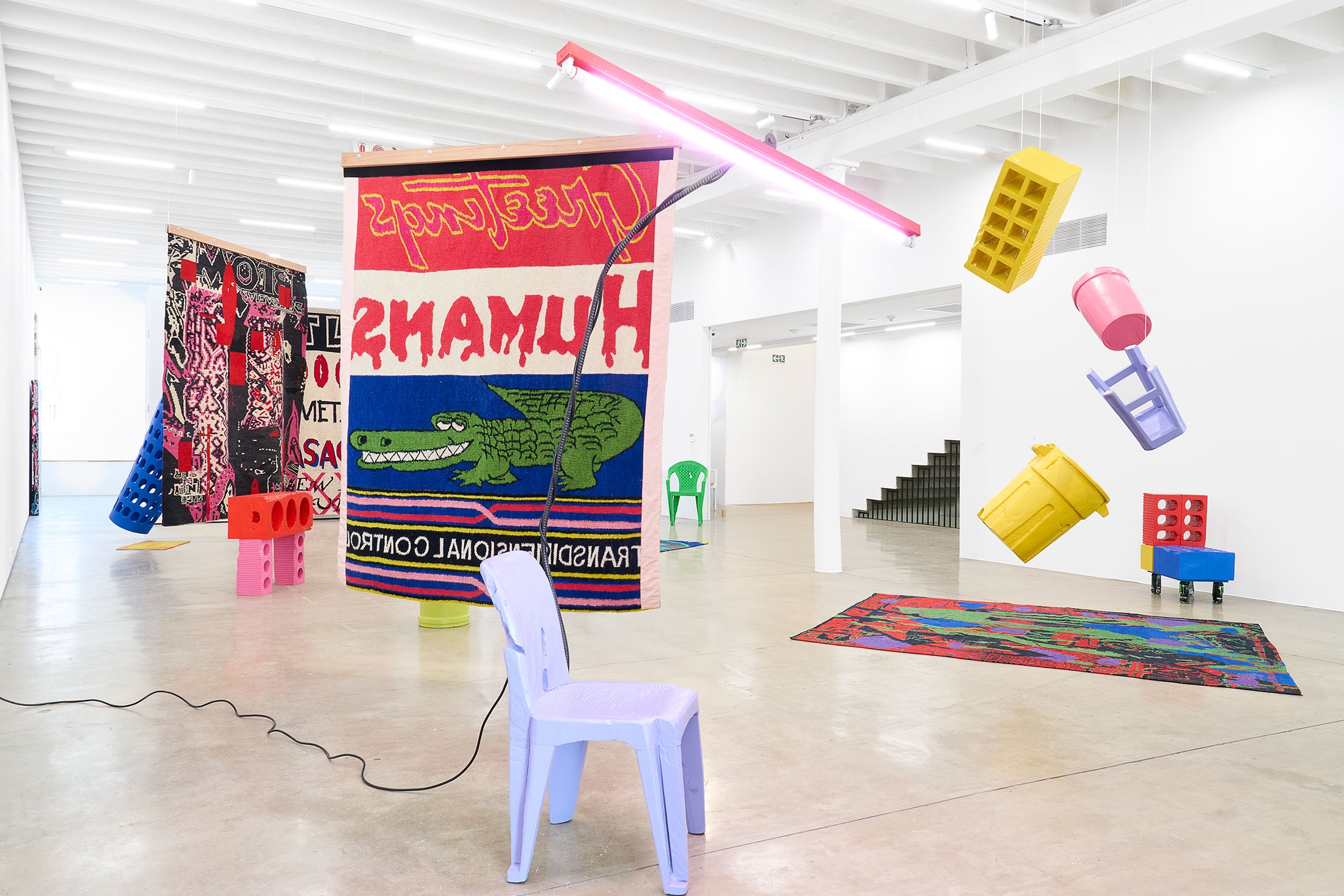
S.d.B. We’ve been using the language of ‘flattening.’ Perhaps it’s nicer to say that you’re elevating the everyday, giving the posture that’s slumped in that chair after a day of work its due tenderness, immortalising that seat. These are proletarian objects: the plastic chair to catch a rest, the Monster Energy drink chugged to survive the day’s labour. You look for the tree; you carve the wood, you treat each part with solemnity. Even though your practice doesn’t scream ‘solemnity’ on the surface, there is a political dimension to it. Punk is political. The whole idea of ‘Interior Design’ can sound like a posh, bourgeois thing to be concerned with. You undo that.
C.P. Thank you for that. Being an artist for me is more like a vocation than a career. The way I feel about it could be compared to someone who knows they want to be a teacher. It’s the interactions with people that are most meaningful to me.
J.G. The sculptures disguise the seriousness that underpins them, entering the room with those pops of colour and such joy, but the imprints carry these sitters and their stories.