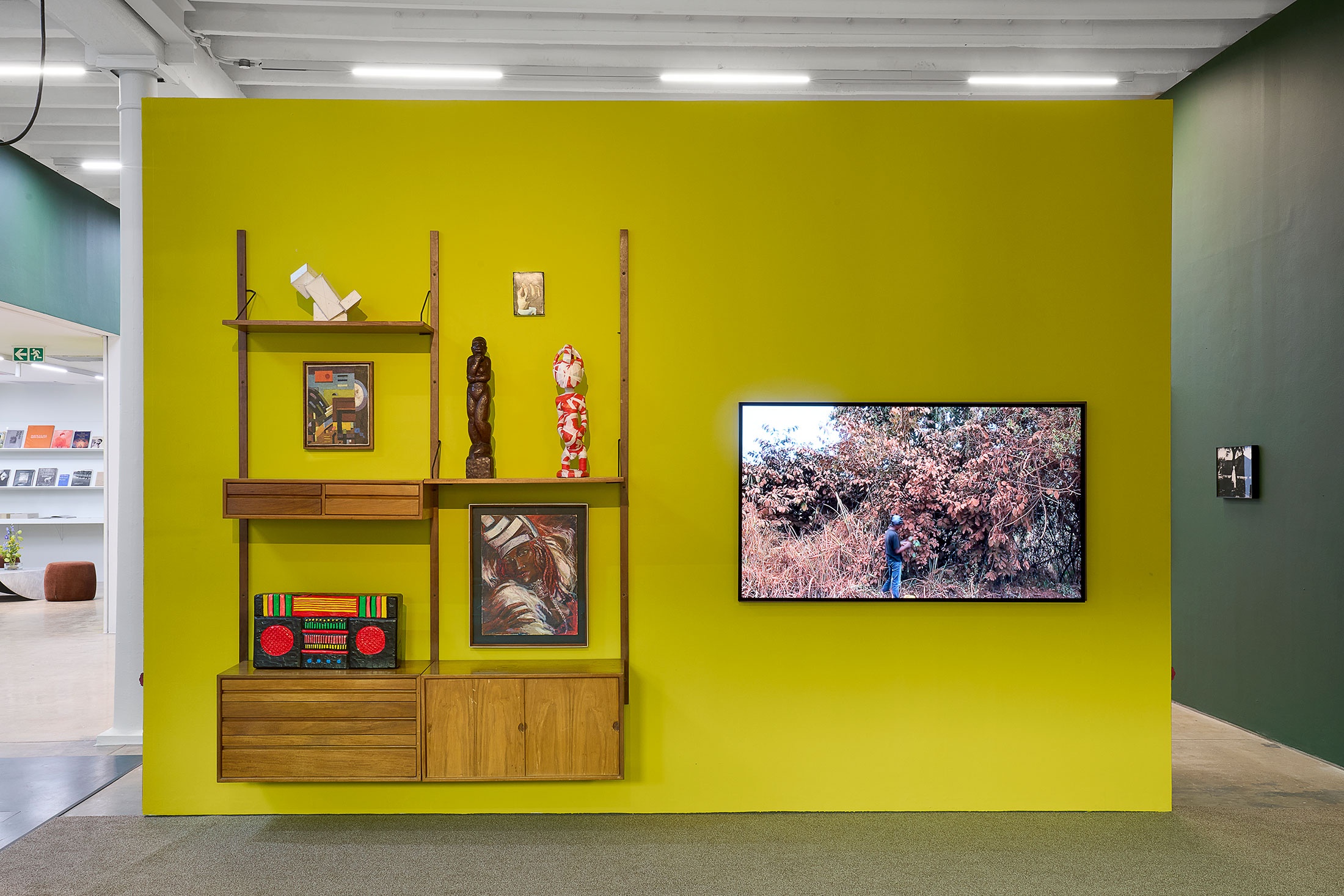
D.M. This conversation about doing something together began last year when I approached you about making a zine. Having known you for years and the care you take in collecting the objects you surround yourself with, I’m interested in how you think about collecting and how you select things. We decided to look at the things that are already here and that A4 is custodian of. What does it mean to look at and work with other people’s collections?
D.K. I’d been thinking about the idea of a home – about the part of a house that feels public but also carries all those elements that remind you that you’re in someone’s personal space. Like the parts of the house that are visible from the outside being a reflection of the people who live inside. You made this particular assortment of things available, within reach. I felt I needed to introduce something personal to me through the selection of works and in the way the space is arranged, the palette of the room, and the inclusion of other objects.
D.M. Art in a collection, in an archive, has its challenges. How to live alongside it? This project is an opportunity to set the mood of a space. When we began making the selection, one of the works that we decided to include was your 02 Jan 2022, made in 2023, a year after the events described. How did this work come about? Were you in town when Parliament was set alight?
D.K. I was in town, yes, and I remember hearing that the building was burning. I remember the day, it could have been a Sunday, it was such a calm morning. It didn’t feel like there was any panic in the air. It wasn’t pressing. We all just got on with it, kept going.
D.M. One of the photographs you used as a reference was from a Daily Maverick article. I’m curious to know how you go about finding the images you later work from.
K.M. Having spoken to you about this previously, Dada, I understand that you often find photos in the way that we all do – the infinite scroll and just being on the internet. I’ve always had the sense that photography as a medium is really important to you, but I hadn’t realised that you yourself engage with film photography. How do you understand the role of photographic images in your work?
D.K. To me, photography restores order in a way. It accesses some kind of truth. When I reproduce a photo, it anchors the work to a particular event. We know that Parliament caught fire on the 2nd January because of photographic evidence.
K.M. Are most of the photos that you reference found photographs, or do you ever work from pictures that you’ve taken yourself?
D.K. It’s a mix of both. I also refer often to screenshots from films, interesting moments where light meets the intensity of one’s facial or physical expression. I keep screenshots and clips of my favourite TV moments.
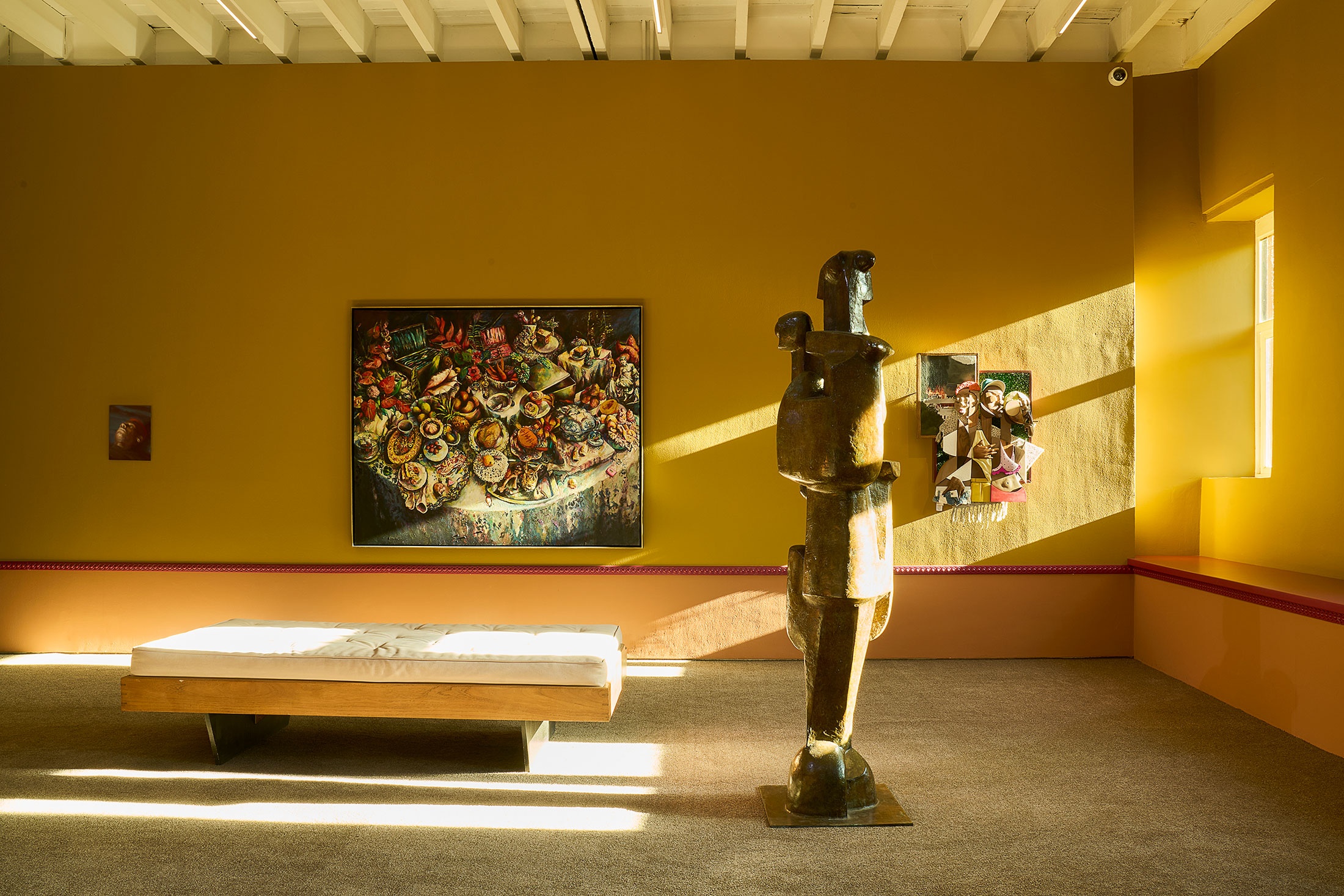
L.D. I feel that the curation of this space is itself a scene-making gesture, which recalls something of the Ponte Tower ‘scenes’ on the far side of the gallery, space ‘1’ in this exhibition. You’re building an environment beyond the discrete works included. There’s a theatrical element to it – if you’d agree with that word. You’re staging an environment in order to produce a given effect.
D.M. I’ve been describing the space as ‘Lynchian’. There’s something about this space that feels perhaps more cinematic than theatrical to me.
D.K. One of the key ideas Daniel and I landed on was creating a listening room. From the beginning, we wanted to include seating and a sound system, a place where we could gather, where people could hang out, get comfortable.
D.M. When we were trying to imagine what the space would be, the idea of people spending time in here became primary. Perhaps it’s ambitious to expect someone to sit down for 15 minutes. But part of that invitation has to do with the furniture. Another is the mood of the room and its contents. How can we shift the default setting of our collective, fragmented attention span?
D.K. The initial question was, “Where’s the central focus?” For now, it’s the TV, right? It’s 31 near-silent minutes of video. You sit here, you take it in. It acts as a window in the space. The action on the screen becomes the action happening outside.
D.M. It’s interesting you say that, Dada, because when we walked into the gallery together, I saw the windows open onto the street for the first time. I’ve worked here for four years, and the windows have always been covered, but as soon as I saw them uncovered, there was a strong sense that we had to leave them like that. Windows recur in your work; they become a way of framing your subjects and your scenes. And then there’s also A4’s proximity to Parliament, which I find really interesting in relation to 02 Jan 2022. We’re only a few hundred metres away. If you look out the window, you can almost see it.
L.D. The Ponte project offers parallels to these reflections. Mikhael Subotzky and Patrick Waterhouse went into these private spaces, into each and every apartment in the building, and spent time with the people who lived there to explain what they were doing, what their project was about. But then, instead of foregrounding the interiors of these homes, they took pictures of all the windows and all the doors and all the TV sets. So you have this catalogue of what everyone was watching, what everyone’s view was, what everyone’s door looked like. It made me think about how the stuff around us tells us so much about who we are as people. Similarly, this collection of works speaks to something about you as people, Daniel and Dada, and as artists.
D.M. Following Lemeeze’s thought, even within this space, there’s a division of a kind, where a quarter of it becomes desaturated, greyscale. We understand this section to represent the archive, or something of the past.
D.K. I’ve been thinking around or thinking about segregation in a very practical, physical way. This does feel like the past, to me, this section. The grayscale images do feel like they belong to a different chronology. Like the work by Neo Matloga – though it’s very contemporary, there’s something about it that takes you back in time. But then, the Goldblatt image could have been taken today. There’s a confusion of distance.
D.M. Where, in comparison, there’s something quite joyous about the main part of the room. I hope we’ve created a comforting space, an invitation to people to step into a world. One of my favourite conversations we’ve had towards this exhibition was when you spoke about the Ernest Mancoba sculpture, Figure of a Woman, from 1936 – the attention to detail in the face and torso, which peters out at the figure’s waist, so that the lower half of the sculpture becomes a cubist abstraction. And I asked you, why do you think Mancoba had made that decision? Do you recall your answer?
D.K. I think I said something along the lines of: you can’t communicate through feet. It’s a wasted effort to render perfectly pedicured toes. It demands too much time. You need to focus on what you can communicate through, like the facial expression, the hands. You can’t communicate with ears either; ears also don’t say anything.
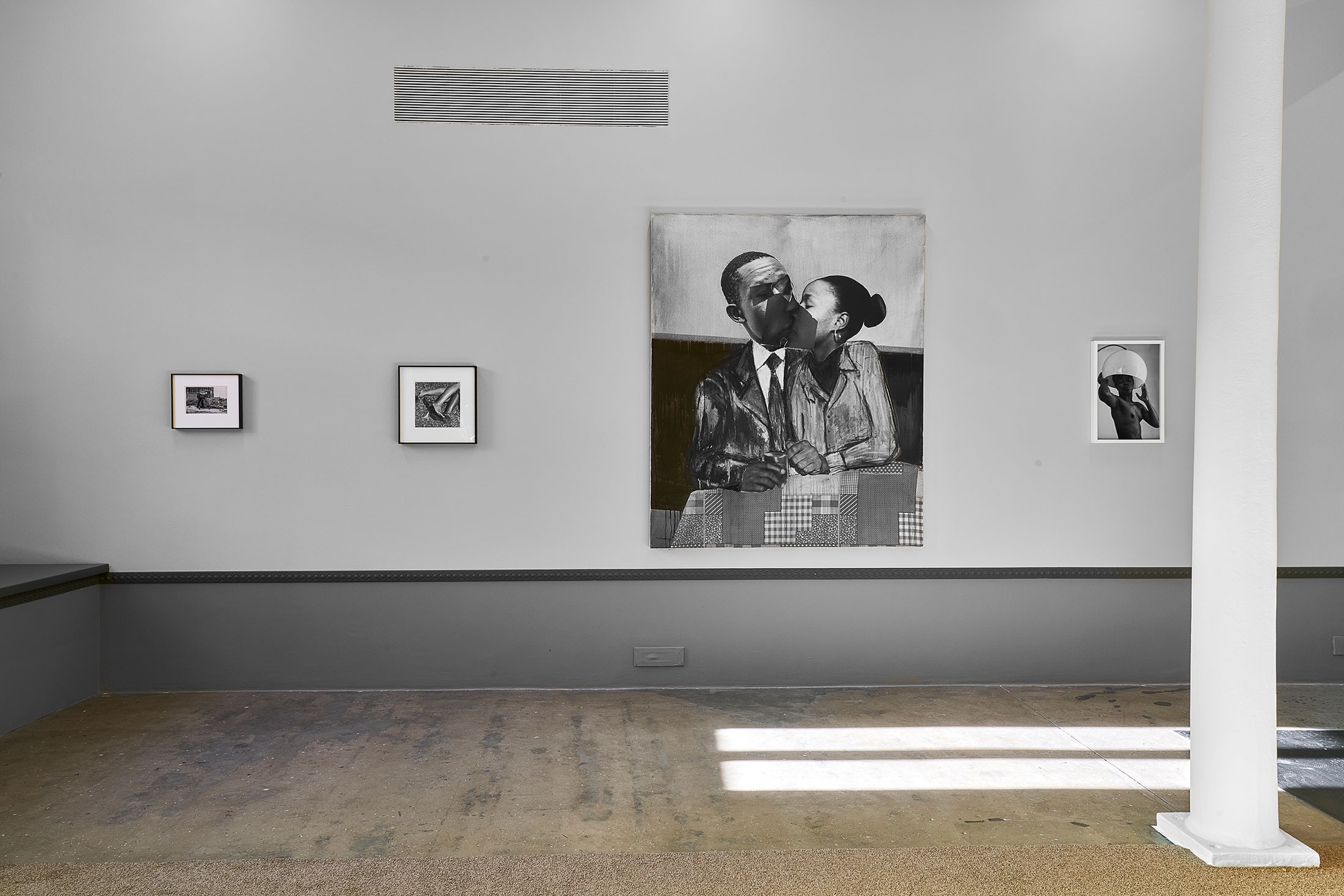
D.M. And that’s apparent in your work, in the compositional decisions you make. Your figures are more often seen from the waist up. But to your point about feet, we’ve included a work from David Goldblatt’s Particulars series you gravitated towards. In these framed feet, there’s so much emotion. The image of people lying on the lawn speaks back to your picnic scene. Ultimately, I think all these works are in conversation with that same work, with 02 Jan 2022. In gathering all these artworks and artists together, how did you make your selection?
D.K. At first, it was largely intuitive. I looked through what you sent me and clicked on whichever thumbnail caught my attention. If I clicked on it, I saved it. This became the shortlist. I thought, “This is what I have, and now let’s look at it.” I remember we then sat down with printouts and narrowed it down. Two groupings became apparent: the grayscale works and the colourful ones, like Penny Siopis’ Setting. But then, how do we contextualise each decision? To express what we are communicating here?
D.M. The way I saw the Siopis work in relation to this project goes back to a conversation we had around chaos and leisure. Here, the artist painted a banquet during apartheid, picturing this sense of excess and indulgence while the world was burning. And I thought there was perhaps a quite literal connection between it and 02 Jan 2022. Perhaps it also goes back to this divide, this segregation of monochromatic and chromatic works.
L.D. And perhaps there’s a correspondence between the three-dimensional quality of this painting and your wall sculptures, Dada.
K.M. Thinking about the room in its entirety, and the kind of feeling that it evokes, and going back to what Lemeeze was saying earlier, it might appear as a domestic space, but really, it’s a theatrical imagining of a domestic space. The idea of creating a place that’s hospitable, a place that feels welcoming, I think that really speaks to the way you communicate in your work, but also you as a person. The desire to facilitate a good time is really present, a sense of generosity and openness to people.
D.M. Generosity is the right word.
L.D. There’s also a playfulness.
D.K. And problem solving, working with the time we have, trying to settle on decisions – the world is big with possibilities.
D.M. I had a million ideas initially, and you said to me, “Don’t waste resources. Make do with what you have available.” And I suppose you’ve always had that inclination.
D.K. I have a workshop full of wood. I can’t buy more wood. That’s my rule. Sometimes we have what we need. I remember us deciding that the green rug we had wanted was –
D.M. Extravagant. It was going to blow the budget. But I kept insisting on it. I kept telling you that I could make it happen. But the truth was, I couldn’t make it happen.
D.K. It’s also important to think, “What will happen to all these things after the show?” I enjoy these limitations. Things and spaces have a long life.