“Rorke’s Drift was no ordinary school,” Peder Gowenius writes in the introduction to Rorke’s Drift: Empowering Prints. When he and Ulla Gowenius landed in South Africa from Sweden, they knew very little about the country. Naive to apartheid, the couple arrived at the mission station in (what is now) Kwa-Zulu Natal with relatively modest aims: to explore traditional craftmaking and whether these crafts could assist women in rural areas to make a living. “The whole idea was absurd and politically unclear,” he writes.
The students became the project’s key collaborators, the teachers’ teachers. Azaria Mbatha and Allina Ndebele-Khumalo were vital contributors who, together with their colleagues, guided the founders to the three cornerstones upon which the Rorke’s Drift Evangelical Lutheran Church Art and Craft Centre would be built:
- That the art made there could, through metaphorical pictures and stories, convey messages that were forbidden or banned in South Africa under apartheid.
- That ‘ordinary’, or western school systems might be inhibitory to creative expression.
- That Rorke’s Drift be self-sufficient, where sanctions on SA made it difficult to access foreign aid, and reliance on foreign donors would be irresponsible.
Ulla Gowenius and her team of weavers accomplished the third cornerstone within the first four years of the art centre’s establishment, through demand for their storied tapestries.
Ten years prior to the establishment of the centre at Rorke’s Drift, in 1952, Cecil Skotnes was appointed as Cultural Recreation Officer at Johannesburg’s Polly Street Art Centre. At the time, Polly Street functioned as an urban community centre with a jazz bent, the extra-curricular educational programme for black South Africans staffed by a cohort of white volunteers from across Joburg’s arts ecosystem. Skotnes was a young artist, inexperienced as an educator. Engaging local businesses and sponsors, he developed a robust arts education programme at the centre that taught life drawing and landscape art while encouraging the development of the distinctive ‘township art’ style of that next decade. Sydney Kumalo, Lucas Sithole, Dumile Feni, Ezrom Legae – these greats were students at Polly Street, and Skotnes’ renown as a mentor and educator travelled beyond its walls. A series of letters in Peter Clarke’s distinctive handwriting dated from the 1960s into the 1980s evidences a warm correspondence between the two artists. Clarke proposed an exchange of prints, to which Skotnes responded with ready enthusiasm. It is perhaps interesting to note that the date of Clarke’s first letter to Skotnes coincided with that of his painting Anxiety (1969), a period of heavy expectation for Clarke. Simon’s Town had been declared a whites-only area. That he would be forcibly removed from his home and relocated to Ocean View was inevitable. With no date yet set, only waiting –
Dear Cecil (if it’s ok with you),
Your fine prints arrived last week.
I was overwhelmed. It really was more than I expected, really very generous
of you considering that the prints I
sent you were so tiny in comparison.
I am very happy to have these prints,
You can be sure…
Anyway, once again, thanks and best wishes,
Peter
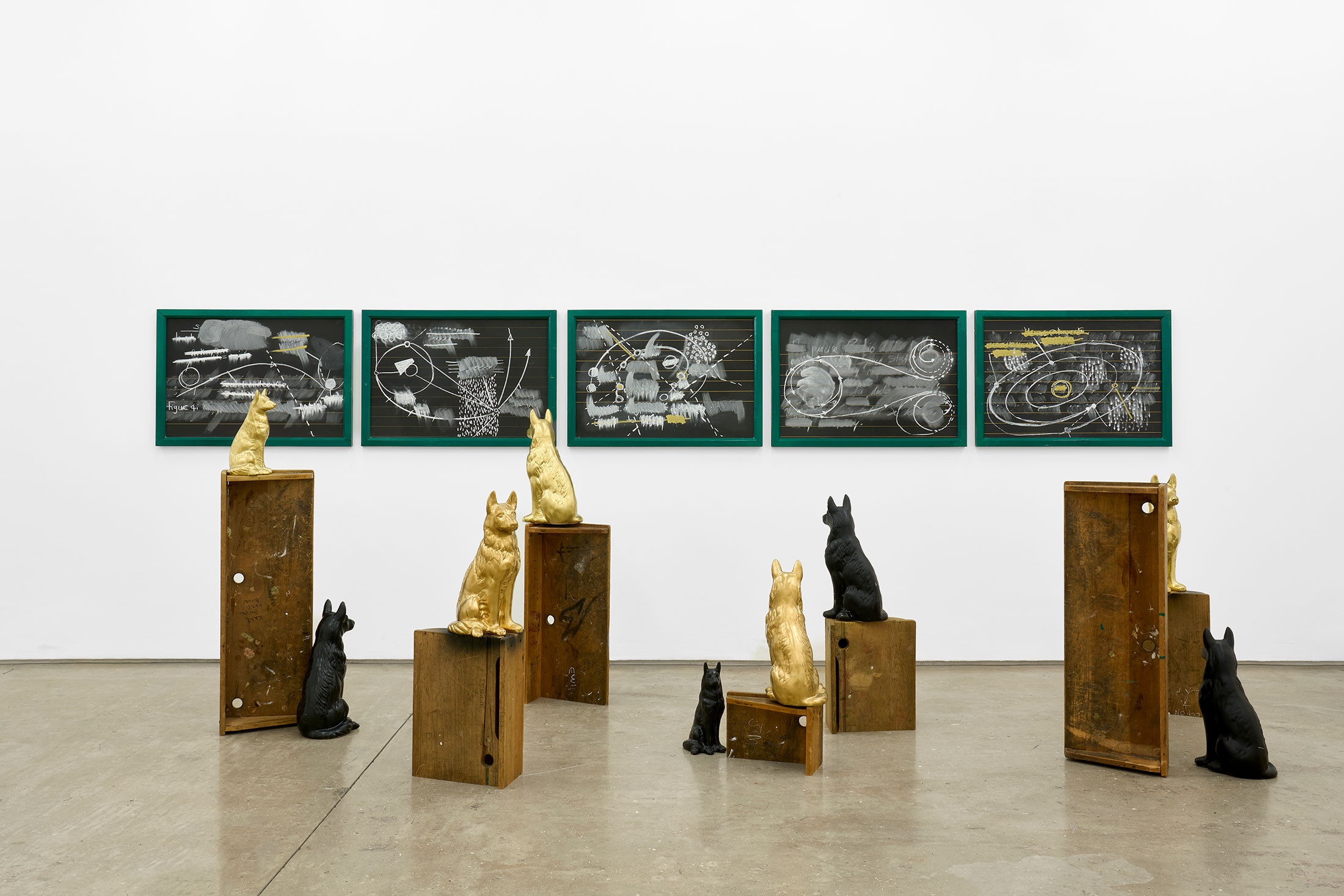
It took a moment of pushing and pulling at the moveable walls for our curatorial team to figure out how much space to give Kemang Wa Lehulere’s Cosmic Interluded Orbit (2016). The installation has remarkable presence. It is so very still. Yet, on the chalkboards, whizzing diagrams, abandoned experiments in magical science – it is these, perhaps, that turned those dogs to gold. Read as an interlude, as its title suggests, everyone’s on a space trip, with the room gone to the dogs. Wa Lehulere is an alchemist. No other artist in South Africa is able to grasp so firmly onto history’s long tail and pull out infrastructure for the imagination. He works best with dimension, where frames and objects jut and push into the room. Modest materials (chalk, bricks, blackboard, repurposed school desks) and these ceramic dogs have recurred throughout his practice. As George Mahashe wrote, Wa Lehulere’s works historicise key moments in this country’s history and “simultaneously inscribe the diversity of concerns animating South African and some diaspora artists; ideas like a fascination with outer space as well as other scientific and occult tendencies.” Writing in 2016, Mahashe bemoaned the exclusion of these themes from a dominant discourse that pigeon-holes these artists only into “conversations about politics of the gaze or some form of self-representation…that only lives within an economy of filling a gap in the Euro-American archive and history.” One wonders how long the orbit will take, what the teacher might have to share on his return.
“Almost everything I found conceptually interesting had to do with paper or books,” Willem Boshoff wrote about the period of working in which he made Blind Cards (1977). “I was also interested in how information was processed and disseminated.” Boshoff was developing a style he referred to as low-definition, but that required effort to decipher, the results of which provoked the mind to engage and puzzle it out, thereby encouraging participation. As libraries were moving towards digitisation, this ‘low-def’ strategy appealed immensely to the artist who, immersed in the theories of Marshall McLuhan, was interested in how knowledge systems are replaced, or cease to be, with respect to the ordering effects that literacy and books may have had on conceptions of space and time.
Kathryn Smith uses the pseudonym serialworks for some of the research-driven curatorial projects she undertakes alongside her studio practice. Alana Blignaut writes that serialworks “undercuts the self-seriousness of modern curatorial stylistics, investing in encounters between individuals singular in their pursuit of curiosity.” In Sightlines, serialworks is used by the A4 team to refer to the Woodstock apartment in which Smith held various engagements, 2009–2012. Converse keeps a seat open for artist-led projects that encourage experimentation and rigour. Faced with ever-increasing obstacles to their existence, project spaces are love letters to fellow practitioners sustained by an obsessive devotion to the practice of art.